
Home / AI Opportunity Workshop
Practical AI Experience
Building and using AI solutions
Triple ISO Certified
(9001, 14001, 27001)
20 Years Delivering
Business Results
Microsoft Solutions
Partner
Most businesses we talk to are in the same spot. The board or the owner wants an AI plan. Staff are already pasting things into ChatGPT. Vendors keep switching on AI features in software you already pay for. And there is a list of ideas somewhere, most of them copied from a LinkedIn post, none of them tied to a problem you actually have.
The workshop exists to replace that list with a short one you can act on. We start with the work that eats your team’s hours, not with the technology. By the end you know which process to fix first, what it will take, and how you will know it worked.

You talk, we write it down. The reason you booked is the reason the first project has to exist.
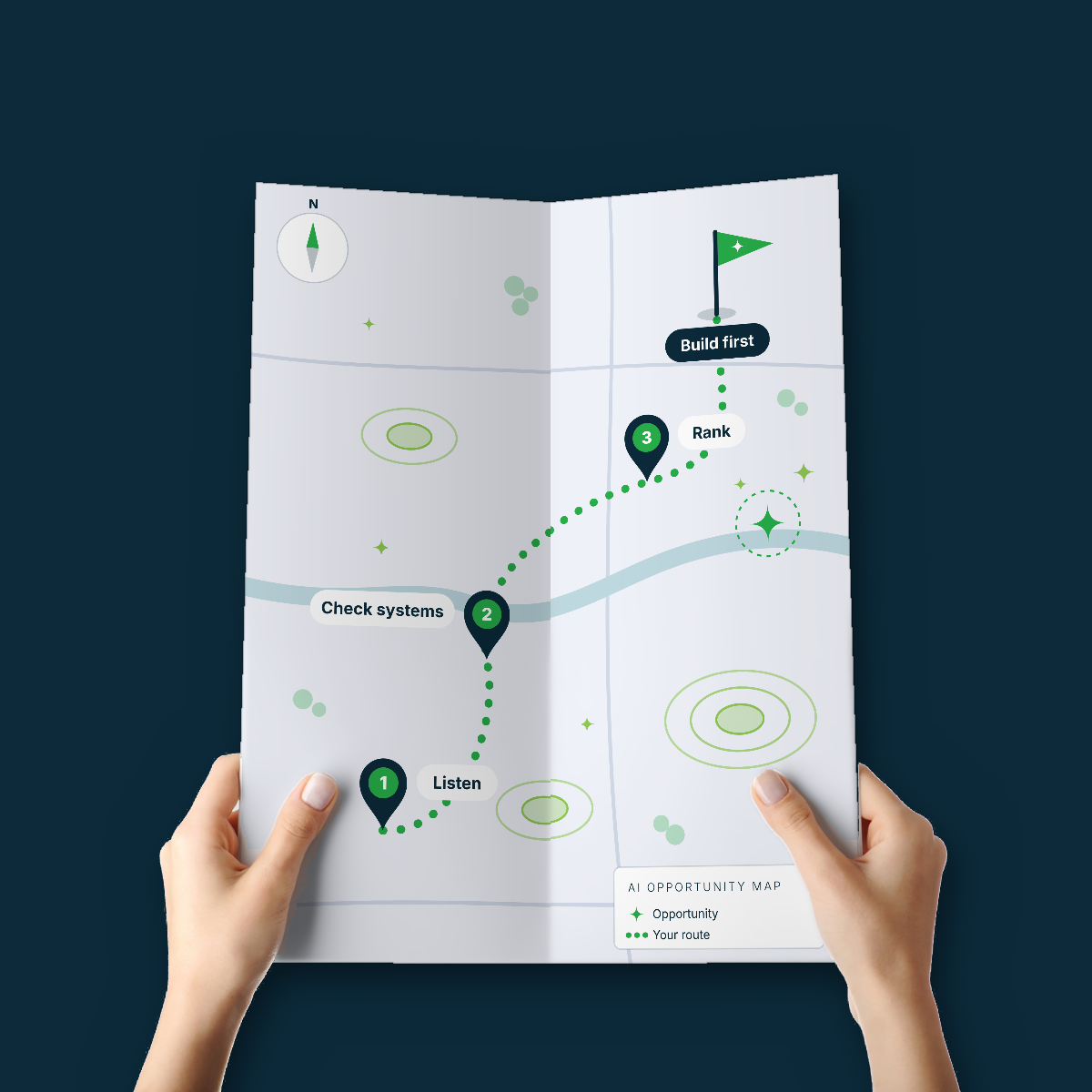
For each of your two or three heaviest processes: who does it, how often, how long it takes, which systems it touches and where it breaks. We are hunting work that is repetitive, high volume and simple enough to write instructions for.
Every person in the room lists the work in their own week that shows the four signs of a good AI candidate: repetitive, reading and writing, copy and paste, and “ask Sharon” (the thing only one person knows how to do).
We put the candidates on an impact versus ease grid. Quick wins first. Ease has nothing to do with technology: it means the process is defined, the information lives in a system, and the right people can get at it.
The best candidate gets written up in six lines: the task in plain language, a named owner, the number that should move, how you will check it is right, which level of AI it needs, and the smallest version you could test in a fortnight.
Within five working days of the workshop, you receive a written plan. It is yours to keep, whether or not you build anything with us.
It covers:
What you told us, in your words
What your systems can support today, and anything that has to be fixed before an opportunity is ready
Your opportunities, ranked, each with the level of AI it needs, the number it should move and the smallest testable version
What to build first, and why
Every opportunity in the Map comes with a price. If you go ahead with the first build, the workshop fee comes off it.
The people who run the processes, not only the people who own them. A good room is four to six people: someone who can decide on budget and priorities, plus the operations manager, the office administrator or the project coordinator who actually does the work and knows where it breaks. If you bring only the leadership team we will spend the first half hour guessing.
Before the day, we ask each attendee to note two things: the task they would hand off tomorrow if they could, and the task nobody does because there is never time.
We are a managed IT provider with 25 staff and a service desk that handles more than 500 helpdesk tickets a week. The same method we use in the workshop is how we chose our own first AI projects.
One example. Triaging and assigning incoming tickets to the right technician used to cost our service coordinator around two days a week. We mapped the process, defined the rules, built an AI workflow and had it in production in seven days. It now triages and assigns every incoming helpdesk ticket, follows our dispatch rules more consistently than we did, and the coordinator has those two days back. We can show you the dashboard.
That is the kind of project the workshop is designed to find: one process, one team, a measurable result in weeks.

The first hour is about your work. Product names come up once, near the end, when there is a job for them.
Every opportunity in the Map has an agreed measure of success before anything is built. No number, no project.
A high-impact process that lives on paper or in one person's head is a process or data project first. We will say so, and it pays off either way.
No. The workshop is platform neutral. The Map tells you which level of AI each opportunity needs, and for many first projects the answer is a tool you already own.
Yes, on Teams. In person works better for the process walk, so we come to you for clients in South East Queensland.
Then the Map says so, and you have spent $2,500 ex GST to avoid spending a great deal more. It happens. More often the finding is that one process needs cleaning up before AI can help, and that is still a result.
No. You do not need to be a managed client. If you are one, we already know your systems, which makes the process walk faster.
A senior consultant from Grassroots IT who has built and run production AI in our own business. We don’t send someone who has only read about it.
No. The AI Opportunity Workshop identifies where AI can benefit your business, while the Claude Enablement Workshop helps your team set up and start using Claude effectively.
Tell us a little about your business and we will come back within one working day with available dates.
$2,500 ex GST fixed fee. Credited toward your first build. Your AI Opportunity Map included.
