
Most engineering and technical firms do not notice their IT setup was built for one office until they open a second.
At 15 or 20 staff under one roof, almost anything works. Files sit on a local server or a shared drive everyone can see. The office network is fast and reliable. If something breaks, someone walks over and looks at it. None of that survives the move to a second site, a remote project office, or a growing field team, and the firms that feel this hardest are the ones whose work depends on real operational complexity: multiple projects, multiple locations, and people who need the same information whether they are at head office or three hours up the highway.
This is a growth story more than an IT one. IT is usually just where it shows up first.
The systems that felt effortless in one office were never actually simple, they just had the benefit of everyone being in the same building. A shared drive works because someone can walk over and ask who has a file open. Support works because a problem can be seen and touched. None of that was ever written down as a plan, so nobody notices it was a plan at all, until a second office removes the thing that was quietly holding it together: proximity.
File access and version control.
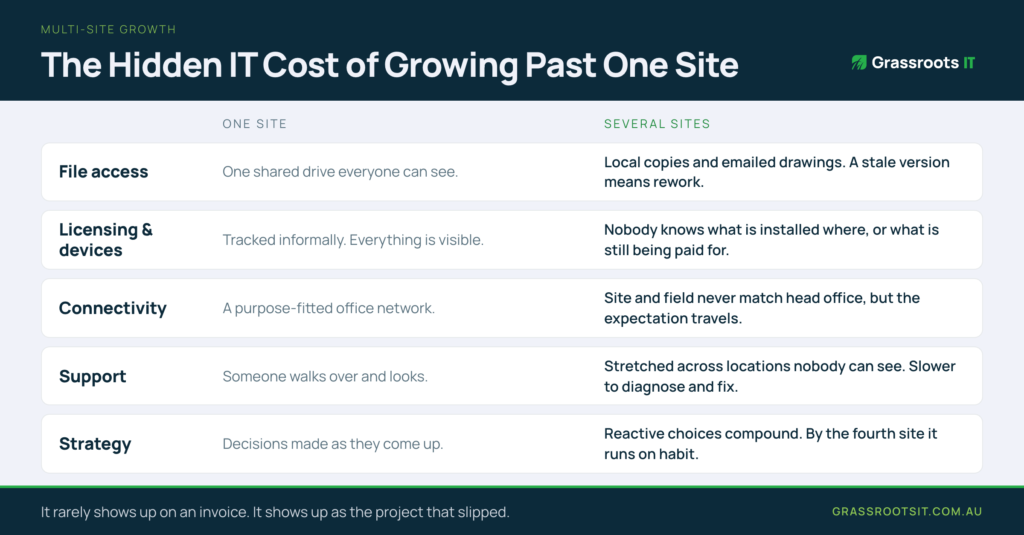
One site: a shared drive or local server that everyone can see and everyone understands. Several sites: staff end up working from local copies, emailing drawings back and forth, or losing time waiting for a connection back to head office just to open a file. On a technical project, a stale version of a drawing is not a minor inconvenience: it means rework, and sometimes a mistake that reaches a client.
Licensing and device management.
One site: software licences tracked informally, because everyone and everything is visible. Several sites: nobody quite knows what is installed where, what is still being paid for, or what is out of date on a laptop that has not been back to head office in months. The cost is never dramatic on any single machine; it accumulates quietly across dozens of them.
Connectivity.
One site: a purpose-fitted office network that just works. Several sites: site offices and field locations rarely get the same reliability, but the expectation that systems “just work” travels with the team anyway, and every dropped connection becomes a support call.
Support.
One site: an informal arrangement, internal or outsourced, sized for one location and one set of problems. Several sites: the same person or provider is now stretched across locations they cannot see, with issues that take longer to diagnose and longer again to fix, because half the job used to be walking over and looking.
Strategy.
One site: infrastructure decisions made as they come up, because the stakes of getting one thing wrong are low. Several sites: those same reactive, site-by-site decisions compound. Each new site adds a bit more complexity to a setup that was never designed to scale, and by the third or fourth site the whole thing is being held together by habit rather than design.
Hardware is beside the point. What matters is whether your systems were designed to support one site or several. A setup built for growth typically has a few things in common: a centralised, cloud-based environment that any authorised person can reach securely from any location, standardised device management so every laptop and site machine meets the same baseline regardless of where it sits, connectivity planned for field and site conditions rather than assumed to match head office, and an IT partner who is thinking about your next site before you open it, not reacting once it is already causing problems.
The firms that get ahead of this treat IT as part of the growth plan itself, rather than something to patch once the second office is already open and struggling. It is a small mindset shift with an outsized payoff: the same investment made a year earlier costs roughly the same, but made a year later it is competing with lost hours, duplicated work, and frustrated staff who have already worked around the problem in their own, less reliable ways.
A simple test is whether your current setup would survive being copied and dropped into a second location tomorrow. If the honest answer involves a password taped to a monitor, a folder structure only one person really understands, or a support arrangement that quietly assumes someone can walk over and look, that is where the real cost is hiding. It rarely shows up on an invoice. It shows up as the project that slipped, the drawing that was a version behind, or the new hire at the second site who spent their first week unable to access half of what they needed.
If you are looking at a new site, a growing field team, or you have already opened one and are feeling the strain, it is worth having that conversation before the next expansion rather than after. We have spent two decades working with engineering and technical firms across South East Queensland through exactly this kind of growth, and the pattern is consistent: the cost of fixing this properly barely changes with time, but the cost of leaving it keeps climbing the longer it sits.
Grassroots IT is a Brisbane-based managed IT services provider specialising in Microsoft solutions for engineering and technical firms across South East Queensland. Learn more about our Cloud Services or IT Support.
Your security tools might be doing their job. The question is whether you can demonstrate that to anyone who asks.
There’s a version of cybersecurity that feels solid from the inside but falls apart the moment someone asks you to account for it. The tools are there. The IT team or provider is on top of things. Nothing has gone wrong. And yet, if a cyber insurer, an enterprise client, or your own board asked you to demonstrate your security posture tomorrow, you’d struggle to know where to start.
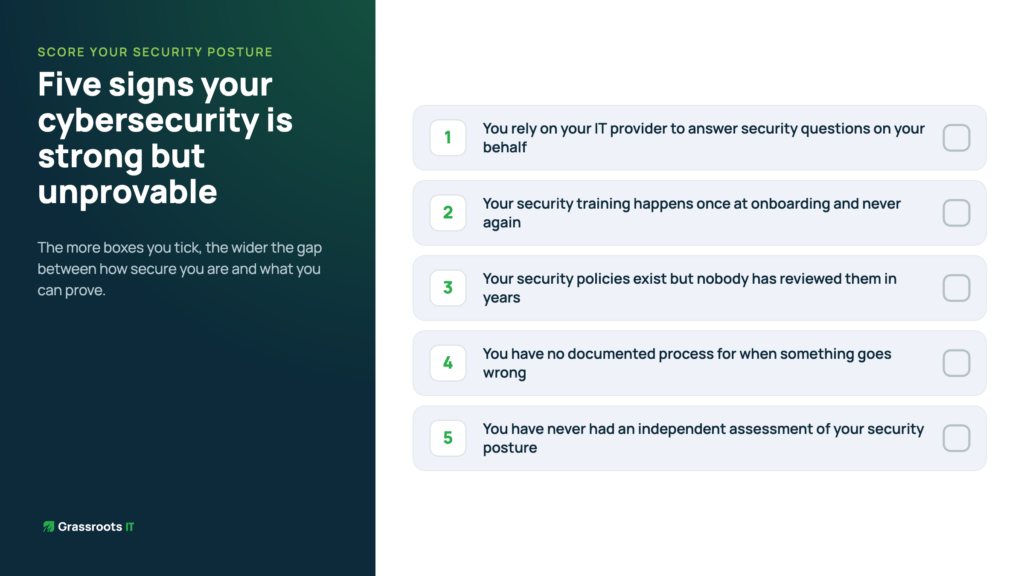
This is more common than most business owners realise, and it’s becoming a genuine liability. Here are five signs you might be in this position.
Cyber insurance is the most immediate place this shift is showing up. Not long ago, insurers would run through a checklist at renewal: multifactor authentication, regular patching, offsite backups. A yes across the board and you’d get your policy.
That process has changed substantially. Australian cyber insurance underwriting tightened significantly through 2024 and 2025. The informal tick-and-flick application form has been replaced by detailed technical questionnaires, and for higher cover, evidence of controls. Businesses that haven’t invested in structured security practices are increasingly finding that cyber insurance is either expensive or simply unavailable.
The market is also about to get more costly. After two years of softening rates, S&P Global forecasts a 15 to 20 per cent premium increase in 2026. Organisations with strong, documented security postures will be better placed to negotiate favourable terms. Those without them won’t.
There’s also a significant coverage gap that most business owners aren’t aware of. Only 10 to 20 per cent of businesses currently carry cyber insurance, compared to 40 to 50 per cent of mid-market firms. That means the majority of small businesses are carrying a risk they’ve largely left unquantified, and uninsured.
The procurement picture is similar. If your business sells to enterprise clients or operates in regulated industries like financial services or healthcare, you may already be fielding questions about your security posture from clients or partners. Insurers are increasingly requesting third-party security attestations, such as framework certifications or maturity assessments, for cover above $1 million. That expectation is spreading beyond the insurance conversation into tenders, contracts, and supplier assessments. It only moves in one direction.
Staff awareness training is one of the most consistently underestimated controls in a small business security program. It’s also one of the first things that gets asked about in an insurance renewal or a client security questionnaire.
A single induction session from two years ago doesn’t count. Neither does a policy document that lives in a shared drive nobody reads. What insurers and certification frameworks are looking for is evidence of regular, completed, documented training: monthly or quarterly cycles, completion tracking, and accountability for non-completion. If you can’t point to records showing your team is actively engaged with security awareness on an ongoing basis, that’s a material gap regardless of how good your technical controls are.
Most businesses at the 30-to-100-staff mark have some version of a password policy, an acceptable use policy, and possibly an incident response plan. What’s less common is any evidence that those documents are current, reviewed regularly, or actually reflect how the business operates.
Outdated policies are a problem for two reasons. First, they may no longer cover the tools, platforms, and working arrangements the business actually uses. A policy written before the shift to hybrid work and cloud storage is almost certainly missing something. Second, they signal to anyone reviewing your security posture that governance is informal, not a managed process. A document dated 2021 that hasn’t been touched since tells its own story.
Most small businesses have a rough idea of what they’d do in the event of a cyber incident: call the IT provider, shut things down, figure it out from there. What most don’t have is a documented, tested incident response plan that assigns roles, defines communication protocols, and sets out a recovery sequence.
This matters more than it might seem. Cyber insurers ask about it directly. More practically, when something goes wrong is the worst possible time to be working out who does what. Businesses that have rehearsed their response, even in a basic tabletop exercise, consistently handle incidents faster and with less collateral damage than those that haven’t. The plan doesn’t need to be long. It needs to exist and be known.
Internal confidence is not the same as verified maturity. Most businesses that haven’t had an external assessment tend to overestimate their position in some areas and have genuine blind spots in others. That’s not a criticism. It’s simply what happens when you’re assessing your own work without a reference standard.
An independent gap assessment against a recognised framework gives you something internal review can’t: a clear, objective picture of where you stand, what’s missing, and how significant the gaps are. For most businesses, the result is more reassuring than expected. The foundations are usually stronger than they think. The gaps tend to be in documentation and formalisation, not in the underlying controls. But until you’ve done the assessment, you’re operating on assumption.
Good cybersecurity and demonstrable cybersecurity are not the same thing. You can have genuinely strong security practices and still be unable to account for them in any meaningful way to an insurer, a client, or a board. That gap is closing as expectations rise, and the businesses that close it proactively are in a significantly better position than those that wait until someone asks.
If any of the five signs above felt familiar, it’s worth understanding where your business actually sits. An independent assessment is a reasonable first step, and for most businesses, the picture is clearer and more manageable than they expect.
Ready to move from research to action? The first step is understanding where you currently stand. A baseline security assessment can break decision paralysis by giving you concrete starting point. Contact us today to discuss your current cybersecurity posture and next best steps forward.
“Pretty secure” isn’t good enough anymore.
That’s the uncomfortable truth we put to our LinkedIn audience recently, and the response told us it landed. Because most businesses answer the cybersecurity question the same way: do we have antivirus, backups, MFA? Yes, yes, yes. So we’re pretty secure, right?
The problem is that “pretty secure” is doing a lot of heavy lifting. Cyber insurers don’t accept pretty secure. Enterprise clients putting you through procurement don’t accept pretty secure. And when something goes wrong, pretty secure won’t hold up in a board conversation either.
The shift happening right now is from cybersecurity as a tool checklist to cybersecurity as something you can actually demonstrate. Not describe. Demonstrate. That’s a different question entirely, and most businesses aren’t ready for it yet.
We spent the last six months getting ready for it ourselves. Here’s what that looked like, and what it means for your business.
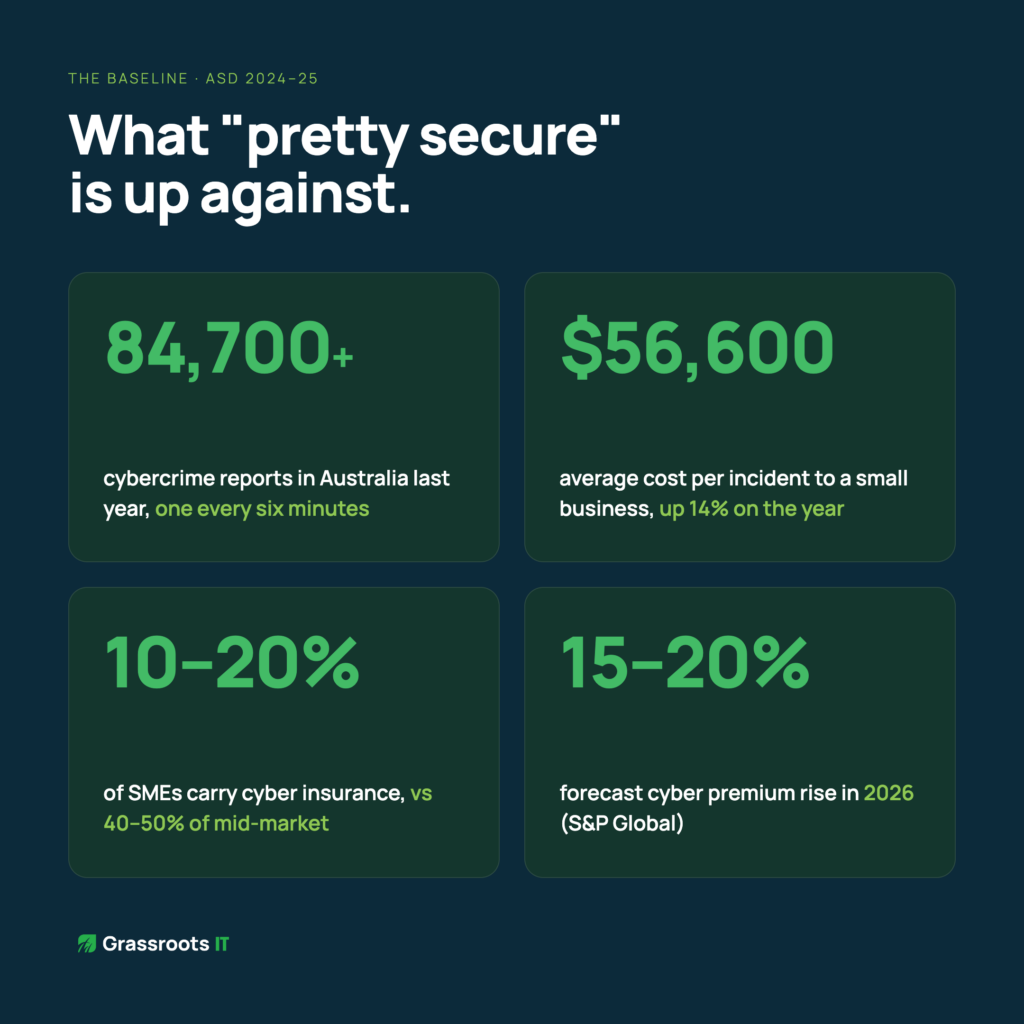
Before we get to the insurance conversation, it helps to understand the baseline. The ASD’s 2024-25 Annual Cyber Threat Report recorded over 84,700 cybercrime reports in Australia last financial year, one every six minutes, with the average cost to small businesses rising 14 per cent to $56,600 per incident. That’s not the cost of a catastrophic breach at a large organisation. That’s the average cost hitting businesses like yours and ours.
What’s notable is how many of those businesses thought they were pretty secure right up until they weren’t.
Cyber insurance is the most immediate place this shift is showing up. Not long ago, insurers would run through a checklist at renewal: multifactor authentication, regular patching, offsite backups. A yes across the board and you’d get your policy.
That process has changed substantially. Australian cyber insurance underwriting tightened significantly through 2024 and 2025. The informal tick-and-flick application form has been replaced by detailed technical questionnaires, and for higher cover, evidence of controls. Businesses that haven’t invested in structured security practices are increasingly finding that cyber insurance is either expensive or simply unavailable.
The market is also about to get more costly. After two years of softening rates, S&P Global forecasts a 15 to 20 per cent premium increase in 2026. Organisations with strong, documented security postures will be better placed to negotiate favourable terms. Those without them won’t.
There’s also a significant coverage gap that most business owners aren’t aware of. Only 10 to 20 per cent of businesses currently carry cyber insurance, compared to 40 to 50 per cent of mid-market firms. That means the majority of small businesses are carrying a risk they’ve largely left unquantified, and uninsured.
The procurement picture is similar. If your business sells to enterprise clients or operates in regulated industries like financial services or healthcare, you may already be fielding questions about your security posture from clients or partners. Insurers are increasingly requesting third-party security attestations, such as framework certifications or maturity assessments, for cover above $1 million. That expectation is spreading beyond the insurance conversation into tenders, contracts, and supplier assessments. It only moves in one direction.
Australia has two well-regarded cybersecurity frameworks that help businesses move from informal security practices to something documented, structured, and verifiable.
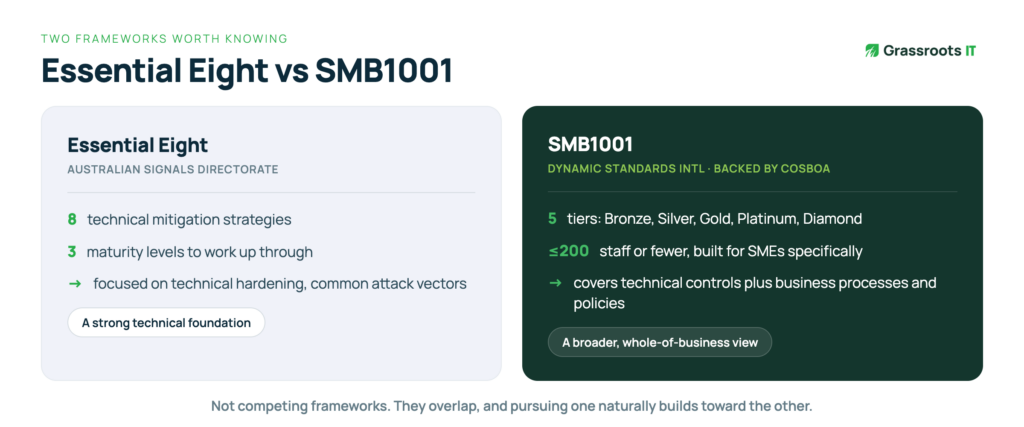
The first is the Essential Eight, developed by the Australian Signals Directorate. Most businesses have heard of it. It covers eight technical mitigation strategies across three maturity levels and is designed to reduce the most common attack vectors. It’s a strong technical foundation.
The second is SMB1001, developed by Dynamic Standards International and backed by the Council of Small Business Organisations Australia. It’s less well known, but it was built specifically for businesses of 200 staff or fewer, which makes it more practical for most businesses. SMB1001 runs across five certification tiers, Bronze, Silver, Gold, Platinum, and Diamond, and covers both technical controls and business processes and policies. Where the Essential Eight focuses primarily on technical hardening, SMB1001 takes a broader view of what a mature security posture looks like across an organisation.
They’re not competing frameworks. They overlap significantly, and pursuing one naturally builds toward the other. The right starting point depends on where your business is now and what your most pressing compliance or assurance needs are.

We recently achieved SMB1001 Gold, the third of five tiers. The process took around six months and covered technical uplifts, policy documentation, and third-party vendor accountability.
What it revealed wasn’t a long list of gaps. It was how much good practice we already had in place that simply wasn’t documented. Cyber awareness training that engineers were completing but nobody was formally tracking. Password governance that existed informally but hadn’t been written down. Account management processes that were sound but undocumented. The certification process forced us to formalise what we were already doing, and in doing so, made it auditable, repeatable, and demonstrable to anyone who asked.
That’s a pattern we see consistently across businesses at the 30-to-100-staff mark. The foundations are often stronger than people think. What’s typically missing is the structure and documentation to prove it.
If your cyber insurer, your biggest client, or your board asked you to demonstrate your cybersecurity maturity tomorrow, not describe it, but demonstrate it, what would you be able to show them?
If the honest answer is not much, that’s worth taking seriously. Not because a breach is necessarily imminent, but because the window for getting ahead of this expectation is narrowing. Businesses that can produce evidence of structured, certified security practices are increasingly differentiated in insurance conversations, in procurement processes, and in client confidence.
The good news is that for most businesses, the starting point isn’t as far away as it looks. A gap assessment against either framework will typically show that a significant portion of requirements are already being met. The work is usually in formalisation and documentation, not in building security from scratch.
If you’re not sure where your business sits, a gap assessment is the logical first step. It gives you a clear picture of what you have, what you’re missing, and what a realistic certification pathway looks like, without committing to anything before you understand the scope.
We’re also hosting a webinar shortly that will walk through both frameworks in detail, compare them side by side, and outline what a practical pathway to certification looks like for a Brisbane business. If this is something your business is starting to think about, it’s a worthwhile hour.
Ready to move from research to action? The first step is understanding where you currently stand. A baseline security assessment can break decision paralysis by giving you concrete starting point. Contact us today to discuss your current cybersecurity posture and next best steps forward.
Sources
Australian Signals Directorate, Annual Cyber Threat Report 2024-25, cyber.gov.au
Cliffside, Cyber Insurance Requirements Australia, cliffside.com.au (March 2026)
4iT, Cyber Insurance for Australian businesses in 2026, 4it.com.au (May 2026)
The most expensive cybersecurity decision most Brisbane businesses make isn’t the wrong product or the wrong vendor. It’s the decision to keep putting off a decision.
We see this pattern regularly: a business leader knows the security posture needs attention. They’ve probably known for a year or more. So they request a couple of quotes, attend a webinar, bookmark a few articles, and tell themselves they’re being diligent. Meanwhile, the calendar moves forward and the actual risk doesn’t go anywhere.
What looks like prudent deliberation is often something else: decision paralysis. And unlike a bad vendor choice, which you can reverse, paralysis has a way of quietly running up a bill that never appears on an invoice.
Decision paralysis around cybersecurity isn’t irrational. It comes from concerns that are genuinely legitimate.
All of these concerns are valid. The problem is that whilst you’re carefully weighing them, costs are accumulating in ways that don’t show up until it’s too late to avoid them.

Decision paralysis carries real costs: most of which don’t appear on invoices or in budgets. Here’s what accumulates whilst you delay:
Cost 1: Rising Insurance Premiums
Cyber insurance premiums have increased 50-100% over the past three years. Insurers now require detailed security questionnaires. Without demonstrated maturity: certifications, documented controls, evidence of ongoing management. You’re in the high-risk category.
The cost: For a typical Brisbane business, the difference between high-risk and demonstrated-maturity premiums can be $5,000-15,000 annually. That’s $60,000-180,000 over three years of delayed security improvements.
Cost 2: Lost Tender Opportunities
More RFPs require security certifications or demonstrated framework compliance. If you can’t tick those boxes, you’re not even shortlisted. Your competitors with Essential Eight or ISO 27001 certifications win by default.
The cost: How many tenders have you declined or not pursued because you knew you couldn’t meet security requirements? Even one missed $100,000+ contract dwarfs most security investments.
Cost 3: Client Confidence Erosion
When clients send security questionnaires and you can’t answer confidently, you’re creating doubt. “We’re working on it” or “That’s on our roadmap” sounds like you’re not taking their data seriously.
The cost: Client relationships are hard to quantify, but erosion is real. Clients who lose confidence in your security posture start evaluating alternatives. By the time they switch, it’s too late to rebuild trust.
Cost 4: Leadership Time Waste
How many hours have you and your leadership team spent researching cybersecurity, getting quotes, attending vendor demonstrations, reviewing proposals, and discussing options without reaching decisions?
The cost: If your leadership team has spent 10 hours monthly for six months researching without deciding, that’s 60 hours. At $200/hour opportunity cost, that’s $12,000 spent on indecision, with nothing to show for it.
Cost 5: Catching Up Is More Expensive
When you finally must improve security, because an insurer demands it, a client requires it, or a regulation mandates it, you’re implementing under pressure. Rushed implementations cost more:
The cost: Urgent security projects typically cost 30-50% more than planned implementations. Plus, quality suffers when you’re racing deadlines.
Cost 6: Regulatory Exposure
Privacy and security regulations are tightening globally. The Australian Privacy Act amendments, mandatory breach notification requirements, and industry-specific regulations all increase compliance obligations.
Businesses that haven’t built security maturity face regulatory risk. When breaches occur, and statistically, they will, demonstrable security efforts influence both regulatory response and public perception.
The cost: Regulatory fines, legal fees, remediation costs, and reputational damage. For Australian businesses, data breach costs on average $4.26 million according to IBM’s 2024 Cost of a Data Breach Report.
Beyond direct costs, decision paralysis carries opportunity costs: benefits you forgo by not improving security:
Competitive Advantage Lost
Security maturity is becoming a competitive differentiator. Businesses that can demonstrate Essential Eight compliance or ISO 27001 certification win contracts against competitors who can’t. They command premium pricing because clients value demonstrated security.
Whilst you delay, competitors are building this advantage.
Strategic Clarity Missed
Businesses with strong security posture make better strategic decisions. They can confidently pursue cloud migrations, enable remote work, adopt new technologies, and expand into regulated industries: all opportunities that require security confidence.
Decision paralysis on security creates decision paralysis on strategy.
The Cost of Deferring
There’s a psychological cost to ongoing uncertainty. Business leaders who aren’t confident in their security spend mental energy worrying. Every news story about a breach triggers anxiety. Every client questionnaire creates stress.
Confidence in your security posture frees mental bandwidth for growth activities.
Understanding the costs of inaction helps, but it doesn’t answer the underlying question: where do you actually start?
In our experience, what breaks the cycle isn’t more information. It is structure. Most of the businesses we work with that have been stuck in research mode for months aren’t lacking data; they’re lacking a decision-making framework and someone they trust to guide them through it.
Trusted guidance matters more than most people realise. When you’re evaluating vendors who all have an interest in the outcome, you can’t get unbiased prioritisation. What actually moves things forward is an adviser who can look at your specific situation and say: given where you are, here’s what matters first, and here’s what can wait.
Recognised frameworks like Essential Eight and SMB1001 are genuinely useful here, not because they make the decision for you, but because they dramatically reduce the number of decisions you need to make. Instead of evaluating every possible security improvement against every other, you’re working through a structured set of proven controls that insurers, clients, and regulators already recognise. The scope becomes manageable.
Staged investment helps too. You don’t need to commit to everything at once, and framing security improvement as a 12-month journey rather than a single project changes the calculus entirely.
But the thing that matters most, and what we see makes the biggest difference, is simply a clear starting point. Most businesses delay because they don’t know where they currently stand. A baseline assessment against a recognised framework gives you that. Once you know the gap between where you are and where you need to be, the next decision becomes obvious rather than overwhelming.
Let’s put the costs of inaction into perspective with actual numbers:

Meanwhile, strategic cybersecurity investment typically ranges from $30,000-60,000 annually for comprehensive guidance and implementation.
The question isn’t whether you can afford to invest in cybersecurity. It’s whether you can afford to keep delaying.
If you recognise your business in any of this, the path forward is simpler than the research phase has probably made it feel.
The gap between where most businesses are and where they need to be is almost always smaller than the paralysis suggests. And the businesses that finally move forward consistently say the same thing: the relief of having a concrete plan, rather than an open-ended research project, was immediate. The hard part wasn’t the work. It was making the first move.
Start by acknowledging that inaction has a cost. Then get a baseline. From there, the decisions get progressively easier, because you’re working from facts rather than estimates.
If you’d like to understand where you currently stand, a baseline assessment against Essential Eight or SMB1001 is the natural first step.
The businesses that make real security progress aren’t necessarily the ones with the biggest budgets. They’re the ones who’ve recognised that structured action, even imperfect action, beats indefinite research.
If you’ve been stuck in cybersecurity decision paralysis, calculate what delay is actually costing you. The number might surprise you, and it might be exactly what finally moves things forward.
Ready to move from research to action? The first step is understanding where you currently stand. A baseline security assessment can break decision paralysis by giving you concrete starting point. Contact us today to discuss your current cybersecurity posture and next best steps forward.
Every business leader knows cybersecurity matters. Yet most still struggle to make meaningful progress. The problem isn’t awareness. It is knowing what to do next.
Most Brisbane business leaders we speak to can articulate the cybersecurity risks their business faces. They’ve read the breach headlines. They know their clients are asking harder questions. They understand the insurance market has changed.
Awareness is no longer the problem.
What most businesses haven’t solved is what comes after awareness: making confident, informed decisions about what to actually do. Ask a business leader what specifically they’re working on, how they decided those were the right priorities, and how they measure progress and that’s usually where the certainty evaporates.
Over the past decade, cybersecurity awareness has skyrocketed. Businesses understand the risks. They’ve read the headlines about ransomware attacks. They know client data needs protecting. They’re aware insurance companies are asking harder questions.
Awareness is no longer the problem.
The problem is what comes after awareness: making informed decisions about what to actually do.
Most businesses get stuck on what we call the Awareness Plateau. They know cybersecurity matters, but without expertise to guide decisions, they’re left guessing:
These aren’t questions about whether cybersecurity matters. They’re questions about how to make progress when you don’t have internal expertise to guide the journey.
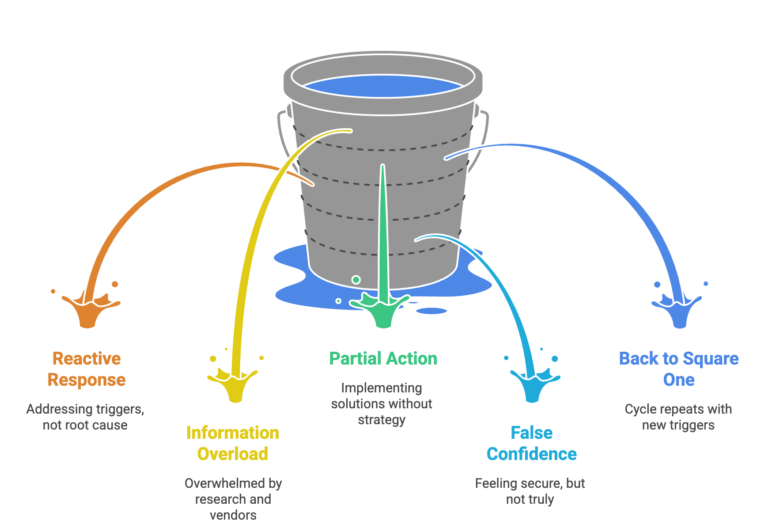
Here’s what the decision-making process looks like for most businesses without dedicated cybersecurity expertise, and it tends to follow a familiar pattern.
Something triggers concern: a client questionnaire, an insurance renewal, a news story about a breach that hits close to home. So the research begins. Google returns millions of results, every vendor claims their solution is the critical one, and the more you read, the more overwhelming it becomes.
Eventually, something gets implemented, usually whatever seemed most urgent or was recommended by the last person you spoke to. A firewall upgrade, a security audit, a new backup solution. For a while, it feels like progress. The immediate concern is addressed and security feels handled.
Then, six months later, another trigger arrives. A different client questionnaire. A new insurance requirement. And the realisation sets in: you’re still not confident about your overall security posture. You still don’t know if you’re focusing on the right things. You’re back to square one.
This cycle repeats because the underlying problem hasn’t changed: security decisions are being made without security expertise to guide them.
Many businesses assume their IT support provider handles cybersecurity. And in a sense, they do, but there’s a critical distinction most people miss.
Your IT support keeps your environment secure operationally. They patch systems, configure firewalls, manage antivirus, respond to incidents, and maintain security configurations. This is essential. It is your security foundation.
But operational security and strategic security are different capabilities:
Operational Security (What IT Support Provides):
Strategic Security (The Missing Layer):
Think of it this way: operational security keeps your house locked and the alarm working. Strategic security ensures you’re protecting the right rooms, meeting building codes, and can prove it to your insurer.
You need both. But most businesses only have the operational layer.
When businesses do seek strategic guidance, they often turn to security frameworks like Essential Eight or ISO 27001. These frameworks are excellent: they represent best practice distilled from thousands of organisations’ experiences.
But here’s what many businesses discover: frameworks tell you what good security looks like. They don’t tell you how to get there from where you are now.
Essential Eight, for example, specifies eight critical controls. For each control, it defines three maturity levels. The documentation is comprehensive and freely available.
Yet businesses still struggle to implement it. Why?
Frameworks are maps. But maps don’t navigate for you. You still need a guide who knows the territory.
Recognising they need expert guidance, many businesses commission a security audit or assessment. This seems logical: get an expert to evaluate your security and recommend improvements.
And it works: to a point. You receive a comprehensive report identifying vulnerabilities and recommending controls. For a moment, you feel clarity. Finally, someone has told you what to do.
Then the report arrives. Forty-seven recommendations. Prioritised as ‘Critical,’ ‘High,’ ‘Medium,’ and ‘Low.’ All valid. All important. All overwhelming.
Now you face new questions:
The audit provided a snapshot. But you need ongoing navigation. Without continued guidance, most audit reports end up filed away, with scattered implementation attempts that never build into coherent security maturity.
One-off audits create what we call ‘Point-in-Time Clarity’: you understand your security posture on the day of the audit. But security is a journey, not a destination. The clarity fades as your environment changes, threats evolve, and you implement controls without verification.
So if awareness isn’t enough, frameworks need interpretation, IT support handles operations not strategy, and one-off audits leave you stuck. What does work?
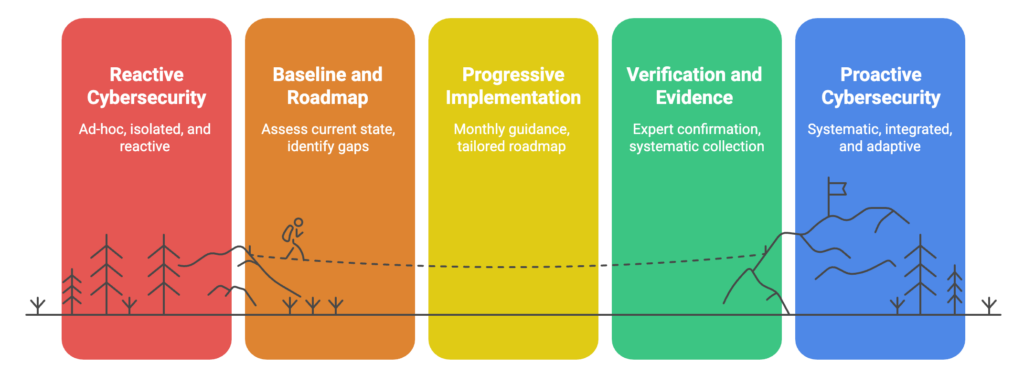
Strategic cybersecurity guidance provides what’s missing: ongoing expert advice that helps you make informed decisions month by month.
Here’s what that looks like in practice:
Month 1: Baseline and Roadmap
Assess where you are across recognised frameworks. Identify what you’ve already implemented and where gaps exist. Create a prioritised roadmap based on your specific situation, not generic recommendations, but tailored guidance considering your industry, risk profile, budget, and capacity.
Months 2-12: Progressive Implementation
Monthly meetings guide you through implementing the next controls on your roadmap. Not rushed: at a pace that suits your team’s capacity. Some months you tackle multiple improvements. Other months you focus on embedding one change properly whilst managing other business priorities.
When obstacles arise, you have expert guidance to overcome them. When circumstances change, the roadmap adapts. When new threats emerge, priorities adjust.
Throughout: Verification and Evidence
As you implement each control, expert verification confirms it’s done properly. Evidence is collected systematically, not scrambled together when audit time arrives. When you’re ready for certifications, everything is organised and prepared.
This approach transforms cybersecurity from guesswork into systematic capability building. You’re not wondering if you’re doing the right things. You have ongoing expert confirmation. You’re not stuck implementing an audit report in isolation. You have continuous guidance adapting to your reality.
The businesses that make real security progress aren’t necessarily the most aware of cybersecurity risks. They’re the ones who’ve stopped treating security as a research project and started treating it as a capability to be built, steadily, with expert guidance.
The good news is that the path from awareness to action is more straightforward than the overwhelm suggests. It starts with understanding where you actually stand, not a rough sense of it, but a proper baseline against a recognised framework. From there, the decisions get progressively clearer, because you’re working from facts rather than estimates.
If you’re stuck on the Awareness Plateau, knowing cybersecurity matters but uncertain about what to do next, a baseline assessment is the natural first step.
