
For years, October has been Cyber Security Awareness Month. In 2026 the Australian Government renamed it Cyber Security Action Month. It’s a small change with a clear message: most small and medium businesses already know the risks. What’s missing is follow-through.
The month sits inside a wider Australian Signals Directorate program called Cyber Action Year 2026. It asks organisations to plan on the basis that a cyber compromise is a matter of “if, not when.” Insurers, auditors and larger clients already think about their suppliers this way, so it’s a useful lens for any business that wants to keep winning work.
Most business owners know they should have multi-factor authentication, and many already use it for email. More and more apps are making it a compulsory part of logging on to accounts these days. The gaps tend to be elsewhere: a shared admin login, an old accounting portal, a supplier system nobody has checked in years.
Those gaps are where incidents happen. The Australian Signals Directorate received over 84,700 cybercrime reports in 2024-25, roughly one every six minutes. The average self-reported cost was $56,600 for a small business, up 14%, and $97,200 for a medium business, up 55%.
Security work rarely feels urgent until something goes wrong. It competes with client deadlines, hiring and month-end, and it usually loses. A month named for action is a good reason to put two or three items in the calendar and see them through.
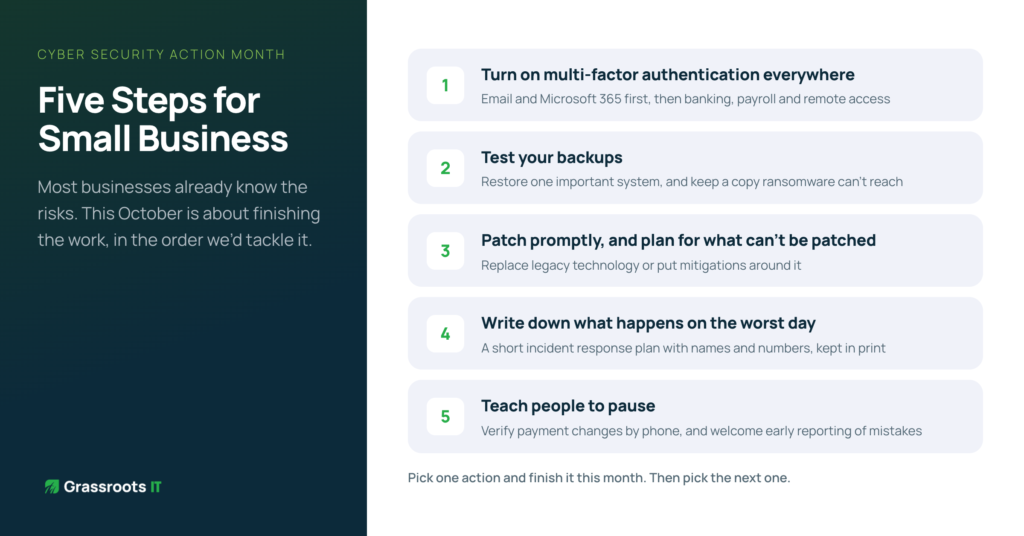
Here are five actions that line up with the basics the that the October campaign promotes, in the order we’d tackle them:
If you’re accountable for technology in your business, try this: if we were breached tomorrow, what would happen in the first hour? Who would you call? Could you still invoice, pay staff and talk to clients?
If the answers are vague, you’ve found your starting point. A tabletop exercise, where your leadership team walks through a realistic scenario together, surfaces gaps faster than almost anything else. It also turns an abstract risk into a set of decisions people have already practised.
It’s also worth checking your cyber insurance policy while you’re there. Many policies list conditions, such as multi-factor authentication or tested backups, that need to be in place for a claim to succeed. Knowing those conditions now is far better than discovering them mid-incident.
The five actions above make you safer. More and more, clients, insurers and tender panels also want you to prove it. Frameworks such as the Essential Eight and SMB1001 help here: they turn good intentions into a structured program with evidence you can show someone else.
We went through this ourselves when Grassroots IT achieved SMB1001 Gold certification. Over about six months, the biggest surprise was how much good practice we already had in place that simply wasn’t documented, so most of the work was writing it down and making it auditable.
Cyber Security Action Month runs until the end of October. It’s a great time to choose one action from this list and finish it before then. Then pick the next one.
SOURCES
