In September, a staff member at a family-owned furniture business in Melbourne’s Bayside area was working through a $118,000 order of outdoor furniture. The emails from the supplier were genuine. Then one arrived saying the supplier’s bank details had changed and the payment was urgent. She paid it.
The supplier hadn’t sent that email. Scammers had got into the thread and were impersonating them. Her bank flagged the transfer as possible fraud, she rang the supplier to check, and Victoria Police, working with the AFP-based Joint Policing Cybercrime Co-ordination Centre, blocked the transaction and returned the money.
SmartCompany reported this story in October, and it struck us as a timely reminder for any business that pays suppliers by bank transfer.
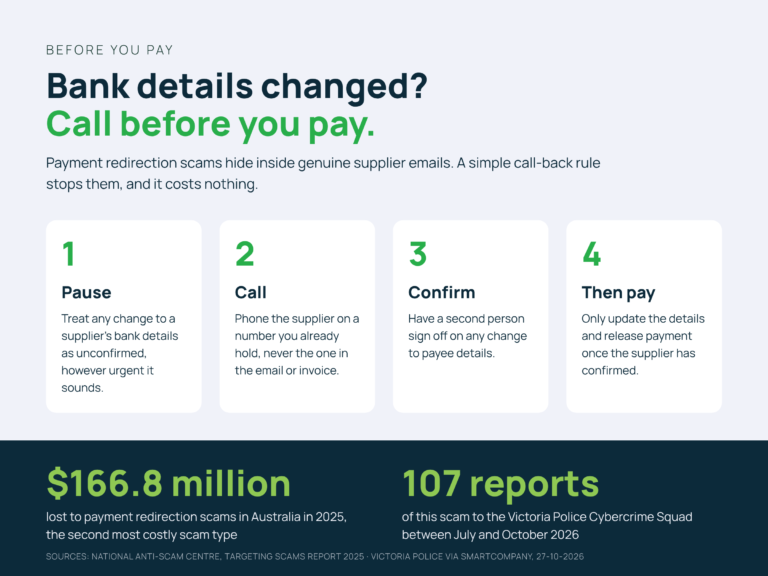
Victoria Police says its Cybercrime Squad has received 107 reports of this scam since July 2026, and the National Anti-Scam Centre puts payment redirection losses at $166.8 million in 2025, second only to investment scams.
Payment redirection is a form of business email compromise, sometimes called invoice fraud. Most scam advice assumes the email looks suspicious. Payment redirection scams work because it doesn’t. Often the scammer has access to a real mailbox, either the supplier’s or yours, and replies inside a real conversation about a real order. The amount is right, the tone is right, and the only thing that changes is the account number.
Then comes the pressure: the payment is overdue, the goods won’t ship, the change needs to happen today. The person processing it is doing what a good accounts team does, keeping a supplier happy and an order moving. That instinct is exactly what the scam relies on.
So training people to spot a dodgy email only goes so far here. You need a process that doesn’t depend on spotting anything.
The most effective control costs nothing: any change to a supplier’s bank details is confirmed by phone, on a number you already hold. That means the number in your supplier file or on their website, never the one in the email or the new invoice.
Two more steps make it stick:
This is the step that saved the Bayside business. A phone call to the supplier confirmed the fraud while there was still time to act.
We practise this ourselves. Our admin team calls to check payment details before we pay invoices, and several of our suppliers have told us they rarely get those calls from other businesses. It takes a couple of minutes, and it’s a habit any business can adopt.
Process catches the request. Technology makes it harder for scammers to get into the conversation in the first place. For most businesses on Microsoft 365, that means:
MFA is one of the Essential Eight strategies, and frameworks like SMB1001 give you a structured way to put these controls in place and show your clients you have.
If you’re not sure where your business stands, our post Cyber Security Action Month: Five Steps for Small Business covers the basics every business should have in place.
Speed matters. The Bayside business got its money back because the bank, the staff member and police all moved quickly.
The end of the year is when accounts teams are busiest, with suppliers chasing payment before the shutdown. That pressure is what these scams feed on. Detective Sergeant Dean Waters of the Victoria Police Cybercrime Squad put it simply: don’t “let a scammer rush you into making a costly mistake”.
If you make one change before the holidays, make it the call-back rule, and make sure everyone who pays invoices knows it applies to them.
October is Cyber Security Action Month, and this year the Australian Government’s message is short: “Take a second. Stay secure.” The idea is that a small pause before you click, share or respond prevents most of the damage.
When it comes to AI and cybersecurity, we think that pause matters most in one particular moment: when someone in your team opens an AI tool.
In most businesses, AI arrives well before an AI policy does. A project manager summarises meeting notes in a free chatbot. Someone in accounts drafts a tricky supplier email. A team leader pastes a spreadsheet in to tidy it up. None of this is malicious. People are trying to get through the day faster, and AI is good at helping them do that.
The risk sits in what gets pasted. The Office of the Australian Information Commissioner recommends that organisations “do not enter personal information, and particularly sensitive information, into publicly available generative AI tools”. Client details, staff records and customer lists often contain exactly that kind of information, and it is easy to paste them without thinking twice.
AI tools handle your data in different ways. Free consumer tools are built for individuals, and their terms on storing and using prompts vary. Microsoft 365 Copilot works inside your Microsoft 365 environment. Microsoft states that Copilot prompts, responses and the data it accesses “aren’t used to train foundation models”, and that Copilot respects your existing permissions, sensitivity labels and retention policies.
That second point cuts both ways. Copilot can see whatever each user can already see. If your SharePoint permissions are loose, Copilot will happily surface the salary spreadsheet someone saved to the wrong folder years ago. Tidy permissions come before new licences (we cover this in more detail in getting your business ready for Microsoft Copilot).
Our view is that the safest path for most businesses is to give staff an approved tool that works inside your Microsoft 365 tenant, and be clear about what never goes into anything else. Banning AI outright tends to push it underground, where you can’t see it at all.
AI has also made scammers more convincing. Phishing emails used to give themselves away with clumsy grammar and odd formatting. AI tools now write clean, well-targeted messages in seconds, in whatever tone the attacker needs.
Email is still the main way in. In the Australian Signals Directorate’s Annual Cyber Threat Report 2024-25, business email compromise fraud with a financial loss made up 15% of cybercrime reported by businesses. The average self-reported cost of cybercrime rose 14% to $56,600 for small businesses, and 55% to $97,200 for medium businesses.
The same technology can mimic a familiar voice or build a convincing copy of a supplier’s website. An “urgent” call from the boss asking for a quick transfer is easier to fake than it used to be.
This is where the campaign’s message earns its place. A short pause catches most of these attempts.
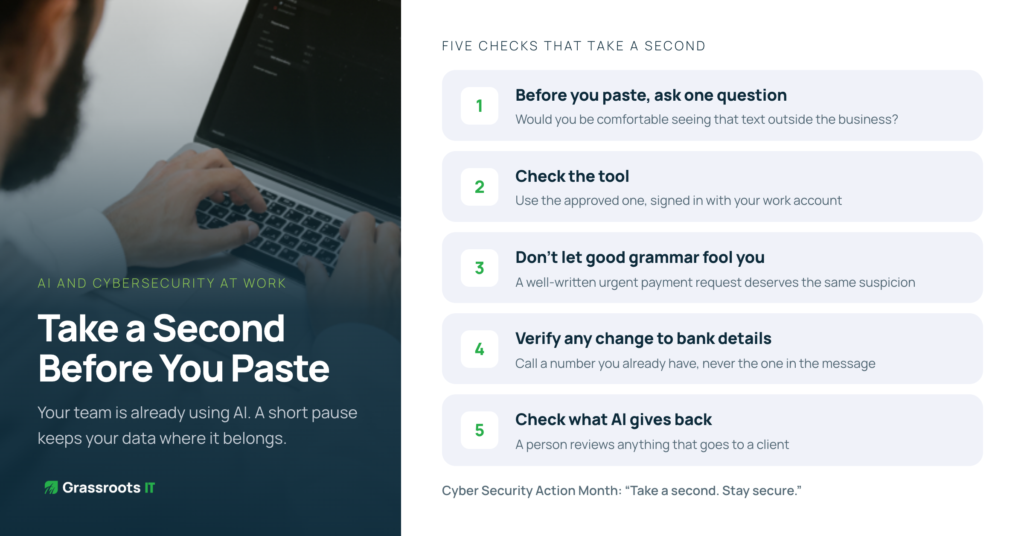
You don’t need a 40-page AI policy. A one-page guideline covering approved tools, what never gets pasted and who to ask is a strong first step. Add a permissions review in Microsoft 365 and a short staff session on AI-assisted scams, and you have covered the biggest gaps.
We saw this with a not-for-profit client that wanted an HR assistant built on Copilot. Before building anything, we talked through where data goes in the free and paid versions of Copilot. We then gave the agent access to just one SharePoint library (policies and procedures), set it to answer only from that content, and tested it with a small group of staff before a wider rollout.
So take a second this October. Ask your team which AI tools they used this week. Their answers will tell you where to start.
SOURCES
For years, October has been Cyber Security Awareness Month. In 2026 the Australian Government renamed it Cyber Security Action Month. It’s a small change with a clear message: most small and medium businesses already know the risks. What’s missing is follow-through.
The month sits inside a wider Australian Signals Directorate program called Cyber Action Year 2026. It asks organisations to plan on the basis that a cyber compromise is a matter of “if, not when.” Insurers, auditors and larger clients already think about their suppliers this way, so it’s a useful lens for any business that wants to keep winning work.
Most business owners know they should have multi-factor authentication, and many already use it for email. More and more apps are making it a compulsory part of logging on to accounts these days. The gaps tend to be elsewhere: a shared admin login, an old accounting portal, a supplier system nobody has checked in years.
Those gaps are where incidents happen. The Australian Signals Directorate received over 84,700 cybercrime reports in 2024-25, roughly one every six minutes. The average self-reported cost was $56,600 for a small business, up 14%, and $97,200 for a medium business, up 55%.
Security work rarely feels urgent until something goes wrong. It competes with client deadlines, hiring and month-end, and it usually loses. A month named for action is a good reason to put two or three items in the calendar and see them through.
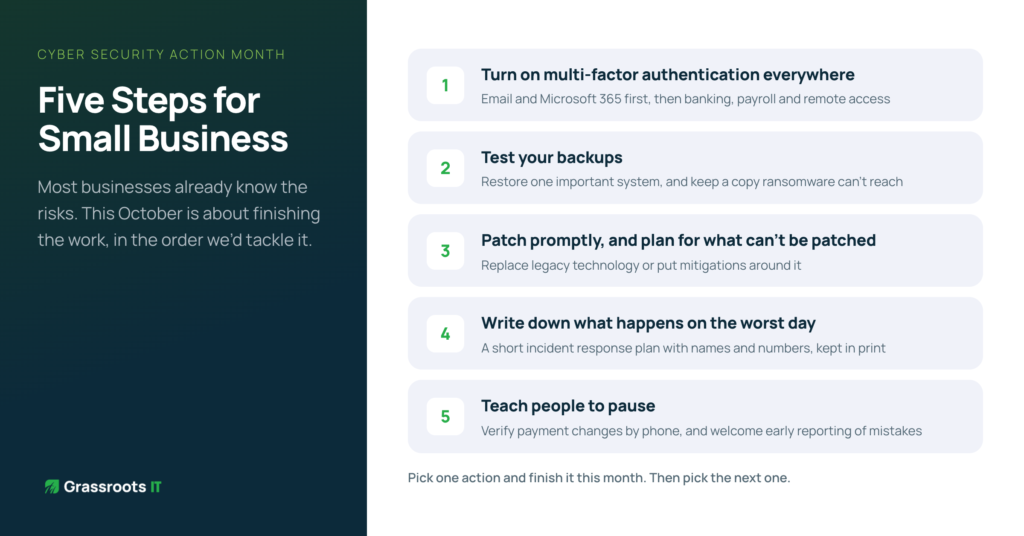
Here are five actions that line up with the basics the that the October campaign promotes, in the order we’d tackle them:
If you’re accountable for technology in your business, try this: if we were breached tomorrow, what would happen in the first hour? Who would you call? Could you still invoice, pay staff and talk to clients?
If the answers are vague, you’ve found your starting point. A tabletop exercise, where your leadership team walks through a realistic scenario together, surfaces gaps faster than almost anything else. It also turns an abstract risk into a set of decisions people have already practised.
It’s also worth checking your cyber insurance policy while you’re there. Many policies list conditions, such as multi-factor authentication or tested backups, that need to be in place for a claim to succeed. Knowing those conditions now is far better than discovering them mid-incident.
The five actions above make you safer. More and more, clients, insurers and tender panels also want you to prove it. Frameworks such as the Essential Eight and SMB1001 help here: they turn good intentions into a structured program with evidence you can show someone else.
We went through this ourselves when Grassroots IT achieved SMB1001 Gold certification. Over about six months, the biggest surprise was how much good practice we already had in place that simply wasn’t documented, so most of the work was writing it down and making it auditable.
Cyber Security Action Month runs until the end of October. It’s a great time to choose one action from this list and finish it before then. Then pick the next one.
SOURCES
A structural or civil engineering firm submits a bid through QTenders for a project it is genuinely well suited to deliver. Strong project history, the right licences, a competitive price. Weeks later, the bid comes back marked down, not on the technical submission, but on a section near the back asking for evidence of a cybersecurity framework. Nobody in the business had prepared an answer for that section, because nobody had ever needed to before.
That scenario is becoming common across Queensland, and it did not come from nowhere.
Under the Queensland Procurement Policy 2026 (QPP 2026), agencies are now required to actively consider cyber security risk, including supply chain risk, as part of every procurement decision, and to build appropriate information and cyber security clauses into the resulting contract. That requirement is scaled to the value, risk and complexity of the procurement, not a fixed checklist applied identically to every contract regardless of size. In practice, it still means a supplier bidding on anything beyond the smallest, lowest-risk work can expect cyber security questions or clauses to appear somewhere in the process, and the supplier who can only offer a verbal assurance is the one most likely to be marked down, or asked to accept a contract clause they have no way of actually meeting.
Agencies are also required to weigh supply chain risk as part of that same consideration, which is where this reaches beyond firms bidding directly to government. A subcontractor working under a head contractor, or a specialist consultant engaged on a government project, can find the same cyber security expectations passed down into their subcontract agreement, even if they never submit a bid to a government buyer directly. A mechanical or electrical subcontractor engaged by a head contractor on a council water treatment upgrade, for instance, can find a cyber security clause sitting in their subcontract, passed down from the head contract above it.
Tier one contractors, mining operators and oil and gas majors have been building the same expectation into their own supplier prequalification for some time. A cybersecurity posture now sits alongside the insurance certificates, ISO manuals and WHS plans that make up a standard prequalification submission for these clients. If your firm is on a mining or utility supplier panel, or hoping to get onto one, this is very likely already part of what you are being assessed against, whether or not it has been called out explicitly. The Essential Eight framework in particular has become a common reference point across both government and private prequalification, to the point where it now shows up as an expected baseline rather than a point of difference.
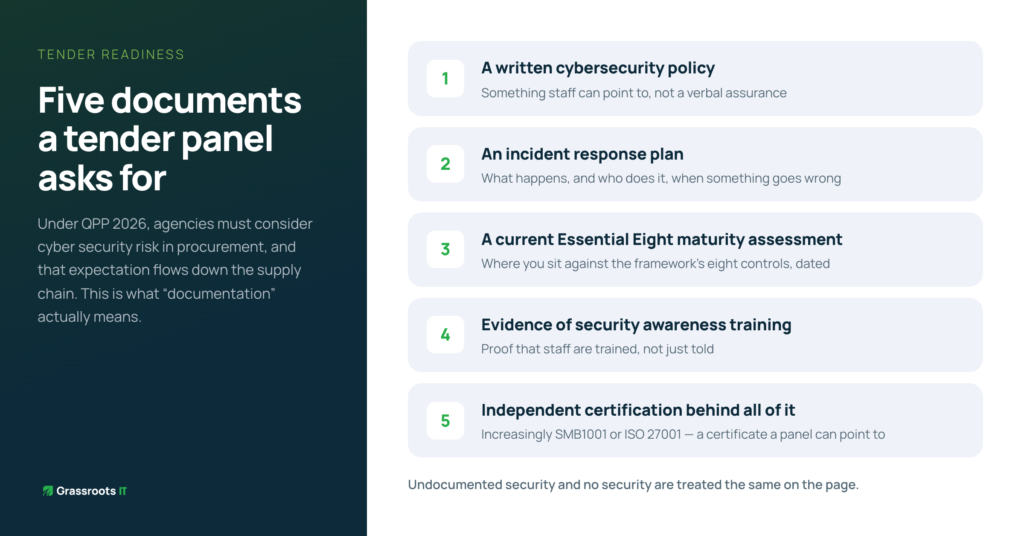
This is the part that trips firms up most, because “documentation” sounds vague until a panel is actually asking for it. In practice, it usually means being able to produce: a written cybersecurity policy that staff can point to, not just a verbal assurance that “we take security seriously”; an incident response plan setting out what actually happens if something goes wrong; a current Essential Eight maturity assessment showing where the business sits against the framework’s eight controls; evidence that staff receive some form of security awareness training; and, increasingly, independent certification such as SMB1001 or ISO 27001 sitting behind all of it. None of this needs to be built from scratch under tender pressure. It is groundwork that, done properly once, gets reused on every bid that asks for it.
Most firms caught out by this do not actually have a security problem. They run sensible IT, have never had an incident, and would probably pass a reasonable security review if anyone sat down and did one. What they lack is the paperwork: a documented framework, an evidenced process, a certificate a panel can point to. A prequalification or tender evaluation has no way to score good practice it cannot see. Undocumented security and no security are treated the same on the page, which is a genuinely frustrating position for a technically excellent firm to find itself in.
Firms getting ahead of this are not scrambling to build a cybersecurity policy the week before a tender closes. They already have a recognised framework in place, such as Essential Eight or SMB1001, documentation ready to attach without weeks of preparation, and, in a growing number of cases, independent certification behind it. Once that groundwork exists, a cybersecurity question on a QTenders submission or a mining panel prequalification stops being a risk and becomes one more thing your firm can answer confidently while a competitor is still working out what to say.
This is where we spend a lot of our time with engineering and technical firms: building security that is not just genuinely good, but provable on demand, whether that is for a QPP 2026 government tender, a supply chain flow-down requirement, or a private prequalification panel. We hold ourselves to the same bar as an ISO 27001 certified provider and an Essential Eight and SMB1001 specialist, so our clients can meet it without having to become security experts themselves.
If your firm bids on Queensland Government work, sits on a supplier panel, or is hoping to get onto one, it is worth finding out now whether your current documentation would hold up, rather than finding out when a bid comes back marked down over a section you did not expect.
Grassroots IT is a Brisbane-based managed IT services provider and Essential Eight and SMB1001 specialist for engineering and technical firms across South East Queensland. Learn more about our Cybersecurity services or SMB1001 program.
Your security tools might be doing their job. The question is whether you can demonstrate that to anyone who asks.
There’s a version of cybersecurity that feels solid from the inside but falls apart the moment someone asks you to account for it. The tools are there. The IT team or provider is on top of things. Nothing has gone wrong. And yet, if a cyber insurer, an enterprise client, or your own board asked you to demonstrate your security posture tomorrow, you’d struggle to know where to start.
This is more common than most business owners realise, and it’s becoming a genuine liability. Here are five signs you might be in this position.
Cyber insurance is the most immediate place this shift is showing up. Not long ago, insurers would run through a checklist at renewal: multifactor authentication, regular patching, offsite backups. A yes across the board and you’d get your policy.
That process has changed substantially. Australian cyber insurance underwriting tightened significantly through 2024 and 2025. The informal tick-and-flick application form has been replaced by detailed technical questionnaires, and for higher cover, evidence of controls. Businesses that haven’t invested in structured security practices are increasingly finding that cyber insurance is either expensive or simply unavailable.
The market is also about to get more costly. After two years of softening rates, S&P Global forecasts a 15 to 20 per cent premium increase in 2026. Organisations with strong, documented security postures will be better placed to negotiate favourable terms. Those without them won’t.
There’s also a significant coverage gap that most business owners aren’t aware of. Only 10 to 20 per cent of businesses currently carry cyber insurance, compared to 40 to 50 per cent of mid-market firms. That means the majority of small businesses are carrying a risk they’ve largely left unquantified, and uninsured.
The procurement picture is similar. If your business sells to enterprise clients or operates in regulated industries like financial services or healthcare, you may already be fielding questions about your security posture from clients or partners. Insurers are increasingly requesting third-party security attestations, such as framework certifications or maturity assessments, for cover above $1 million. That expectation is spreading beyond the insurance conversation into tenders, contracts, and supplier assessments. It only moves in one direction.
Staff awareness training is one of the most consistently underestimated controls in a small business security program. It’s also one of the first things that gets asked about in an insurance renewal or a client security questionnaire.
A single induction session from two years ago doesn’t count. Neither does a policy document that lives in a shared drive nobody reads. What insurers and certification frameworks are looking for is evidence of regular, completed, documented training: monthly or quarterly cycles, completion tracking, and accountability for non-completion. If you can’t point to records showing your team is actively engaged with security awareness on an ongoing basis, that’s a material gap regardless of how good your technical controls are.
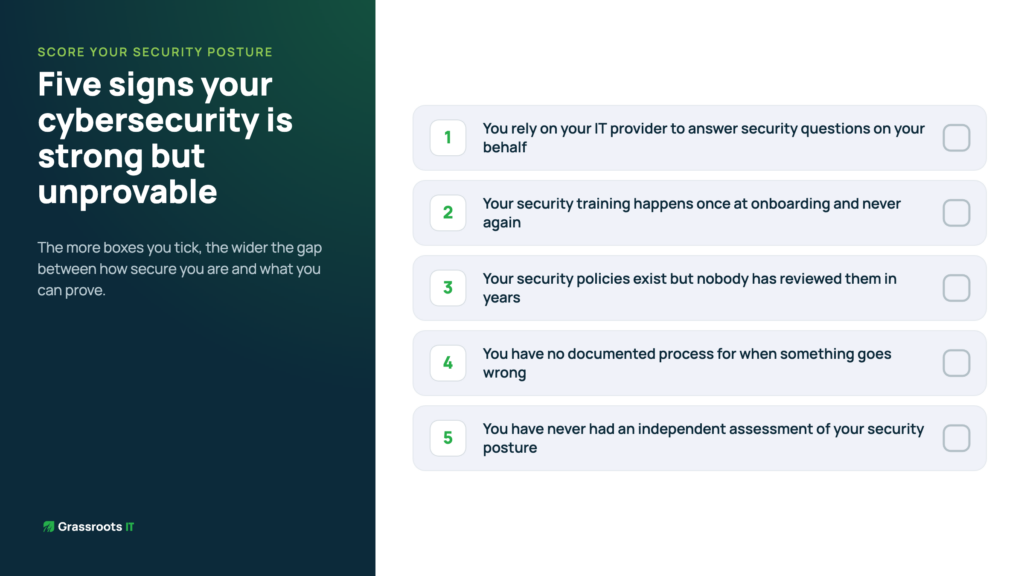
Most businesses at the 30-to-100-staff mark have some version of a password policy, an acceptable use policy, and possibly an incident response plan. What’s less common is any evidence that those documents are current, reviewed regularly, or actually reflect how the business operates.
Outdated policies are a problem for two reasons. First, they may no longer cover the tools, platforms, and working arrangements the business actually uses. A policy written before the shift to hybrid work and cloud storage is almost certainly missing something. Second, they signal to anyone reviewing your security posture that governance is informal, not a managed process. A document dated 2021 that hasn’t been touched since tells its own story.
Most small businesses have a rough idea of what they’d do in the event of a cyber incident: call the IT provider, shut things down, figure it out from there. What most don’t have is a documented, tested incident response plan that assigns roles, defines communication protocols, and sets out a recovery sequence.
This matters more than it might seem. Cyber insurers ask about it directly. More practically, when something goes wrong is the worst possible time to be working out who does what. Businesses that have rehearsed their response, even in a basic tabletop exercise, consistently handle incidents faster and with less collateral damage than those that haven’t. The plan doesn’t need to be long. It needs to exist and be known.
Internal confidence is not the same as verified maturity. Most businesses that haven’t had an external assessment tend to overestimate their position in some areas and have genuine blind spots in others. That’s not a criticism. It’s simply what happens when you’re assessing your own work without a reference standard.
An independent gap assessment against a recognised framework gives you something internal review can’t: a clear, objective picture of where you stand, what’s missing, and how significant the gaps are. For most businesses, the result is more reassuring than expected. The foundations are usually stronger than they think. The gaps tend to be in documentation and formalisation, not in the underlying controls. But until you’ve done the assessment, you’re operating on assumption.
Good cybersecurity and demonstrable cybersecurity are not the same thing. You can have genuinely strong security practices and still be unable to account for them in any meaningful way to an insurer, a client, or a board. That gap is closing as expectations rise, and the businesses that close it proactively are in a significantly better position than those that wait until someone asks.
If any of the five signs above felt familiar, it’s worth understanding where your business actually sits. An independent assessment is a reasonable first step, and for most businesses, the picture is clearer and more manageable than they expect.
Ready to move from research to action? The first step is understanding where you currently stand. A baseline security assessment can break decision paralysis by giving you concrete starting point. Contact us today to discuss your current cybersecurity posture and next best steps forward.
“Pretty secure” isn’t good enough anymore.
That’s the uncomfortable truth we put to our LinkedIn audience recently, and the response told us it landed. Because most businesses answer the cybersecurity question the same way: do we have antivirus, backups, MFA? Yes, yes, yes. So we’re pretty secure, right?
The problem is that “pretty secure” is doing a lot of heavy lifting. Cyber insurers don’t accept pretty secure. Enterprise clients putting you through procurement don’t accept pretty secure. And when something goes wrong, pretty secure won’t hold up in a board conversation either.
The shift happening right now is from cybersecurity as a tool checklist to cybersecurity as something you can actually demonstrate. Not describe. Demonstrate. That’s a different question entirely, and most businesses aren’t ready for it yet.
We spent the last six months getting ready for it ourselves. Here’s what that looked like, and what it means for your business.
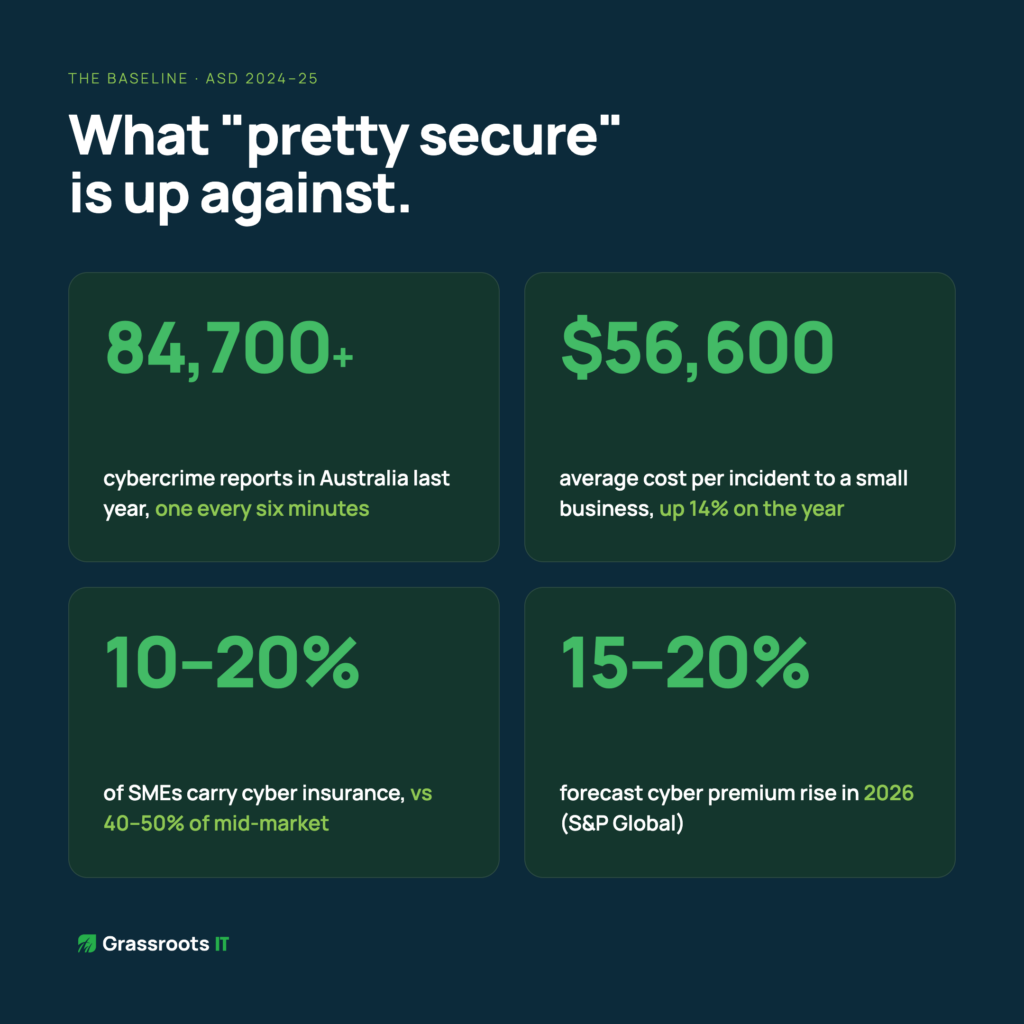
Before we get to the insurance conversation, it helps to understand the baseline. The ASD’s 2024-25 Annual Cyber Threat Report recorded over 84,700 cybercrime reports in Australia last financial year, one every six minutes, with the average cost to small businesses rising 14 per cent to $56,600 per incident. That’s not the cost of a catastrophic breach at a large organisation. That’s the average cost hitting businesses like yours and ours.
What’s notable is how many of those businesses thought they were pretty secure right up until they weren’t.
Cyber insurance is the most immediate place this shift is showing up. Not long ago, insurers would run through a checklist at renewal: multifactor authentication, regular patching, offsite backups. A yes across the board and you’d get your policy.
That process has changed substantially. Australian cyber insurance underwriting tightened significantly through 2024 and 2025. The informal tick-and-flick application form has been replaced by detailed technical questionnaires, and for higher cover, evidence of controls. Businesses that haven’t invested in structured security practices are increasingly finding that cyber insurance is either expensive or simply unavailable.
The market is also about to get more costly. After two years of softening rates, S&P Global forecasts a 15 to 20 per cent premium increase in 2026. Organisations with strong, documented security postures will be better placed to negotiate favourable terms. Those without them won’t.
There’s also a significant coverage gap that most business owners aren’t aware of. Only 10 to 20 per cent of businesses currently carry cyber insurance, compared to 40 to 50 per cent of mid-market firms. That means the majority of small businesses are carrying a risk they’ve largely left unquantified, and uninsured.
The procurement picture is similar. If your business sells to enterprise clients or operates in regulated industries like financial services or healthcare, you may already be fielding questions about your security posture from clients or partners. Insurers are increasingly requesting third-party security attestations, such as framework certifications or maturity assessments, for cover above $1 million. That expectation is spreading beyond the insurance conversation into tenders, contracts, and supplier assessments. It only moves in one direction.
Australia has two well-regarded cybersecurity frameworks that help businesses move from informal security practices to something documented, structured, and verifiable.
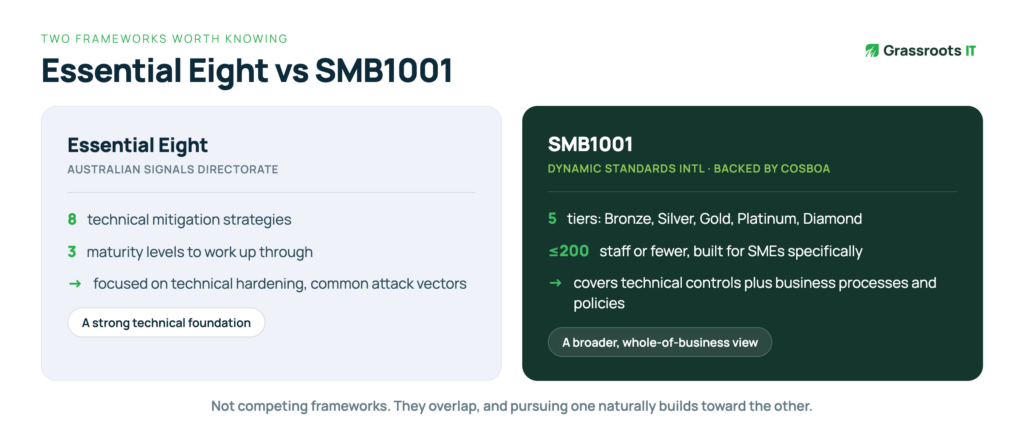
The first is the Essential Eight, developed by the Australian Signals Directorate. Most businesses have heard of it. It covers eight technical mitigation strategies across three maturity levels and is designed to reduce the most common attack vectors. It’s a strong technical foundation.
The second is SMB1001, developed by Dynamic Standards International and backed by the Council of Small Business Organisations Australia. It’s less well known, but it was built specifically for businesses of 200 staff or fewer, which makes it more practical for most businesses. SMB1001 runs across five certification tiers, Bronze, Silver, Gold, Platinum, and Diamond, and covers both technical controls and business processes and policies. Where the Essential Eight focuses primarily on technical hardening, SMB1001 takes a broader view of what a mature security posture looks like across an organisation.
They’re not competing frameworks. They overlap significantly, and pursuing one naturally builds toward the other. The right starting point depends on where your business is now and what your most pressing compliance or assurance needs are.
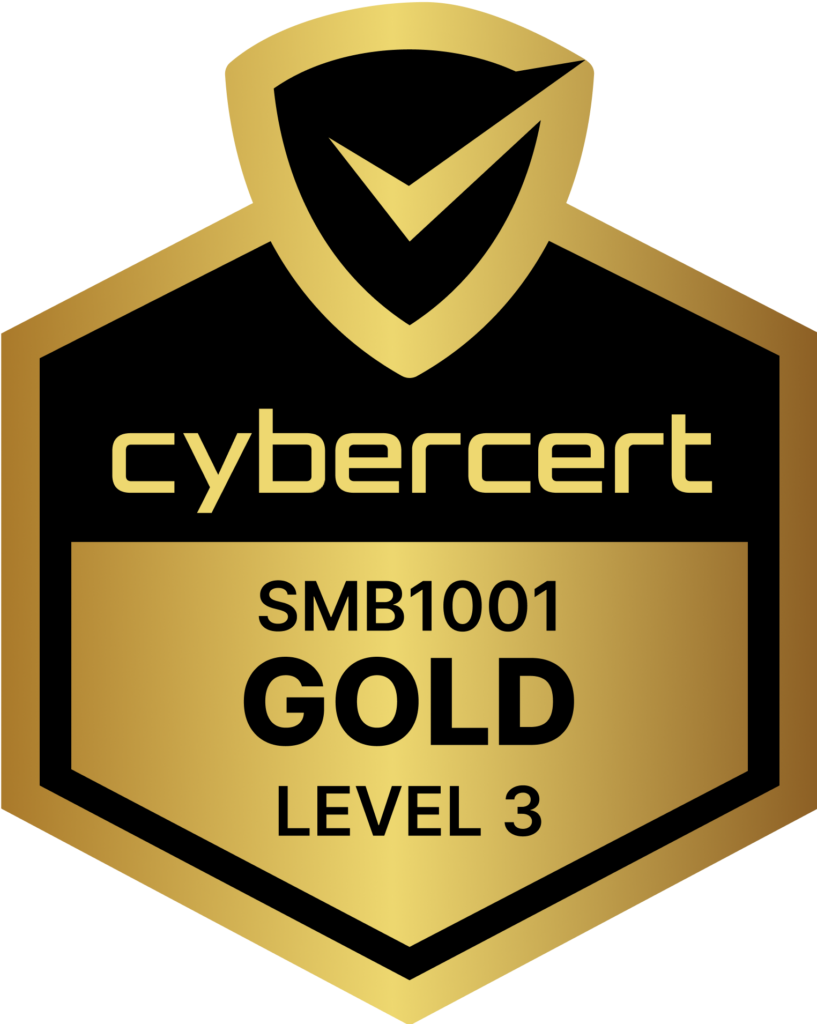
We recently achieved SMB1001 Gold, the third of five tiers. The process took around six months and covered technical uplifts, policy documentation, and third-party vendor accountability.
What it revealed wasn’t a long list of gaps. It was how much good practice we already had in place that simply wasn’t documented. Cyber awareness training that engineers were completing but nobody was formally tracking. Password governance that existed informally but hadn’t been written down. Account management processes that were sound but undocumented. The certification process forced us to formalise what we were already doing, and in doing so, made it auditable, repeatable, and demonstrable to anyone who asked.
That’s a pattern we see consistently across businesses at the 30-to-100-staff mark. The foundations are often stronger than people think. What’s typically missing is the structure and documentation to prove it.
If your cyber insurer, your biggest client, or your board asked you to demonstrate your cybersecurity maturity tomorrow, not describe it, but demonstrate it, what would you be able to show them?
If the honest answer is not much, that’s worth taking seriously. Not because a breach is necessarily imminent, but because the window for getting ahead of this expectation is narrowing. Businesses that can produce evidence of structured, certified security practices are increasingly differentiated in insurance conversations, in procurement processes, and in client confidence.
The good news is that for most businesses, the starting point isn’t as far away as it looks. A gap assessment against either framework will typically show that a significant portion of requirements are already being met. The work is usually in formalisation and documentation, not in building security from scratch.
If you’re not sure where your business sits, a gap assessment is the logical first step. It gives you a clear picture of what you have, what you’re missing, and what a realistic certification pathway looks like, without committing to anything before you understand the scope.
We’re also hosting a webinar shortly that will walk through both frameworks in detail, compare them side by side, and outline what a practical pathway to certification looks like for a Brisbane business. If this is something your business is starting to think about, it’s a worthwhile hour.
Ready to move from research to action? The first step is understanding where you currently stand. A baseline security assessment can break decision paralysis by giving you concrete starting point. Contact us today to discuss your current cybersecurity posture and next best steps forward.
Sources
Australian Signals Directorate, Annual Cyber Threat Report 2024-25, cyber.gov.au
Cliffside, Cyber Insurance Requirements Australia, cliffside.com.au (March 2026)
4iT, Cyber Insurance for Australian businesses in 2026, 4it.com.au (May 2026)