Why Knowing Cybersecurity Is Important Isn't Enough
Every business leader knows cybersecurity matters. Yet most still struggle to make meaningful progress. The problem isn’t awareness—it’s knowing what to do next.
Walk into any Brisbane boardroom and ask about cybersecurity. You’ll hear the same response: “Yes, we know it’s important. We’re working on it.”
But dig a little deeper. Ask what specifically they’re working on. Ask how they decided those were the right priorities. Ask how they measure progress.
That’s when the certainty evaporates.
The Awareness Plateau
Over the past decade, cybersecurity awareness has skyrocketed. Businesses understand the risks. They’ve read the headlines about ransomware attacks. They know client data needs protecting. They’re aware insurance companies are asking harder questions.
Awareness is no longer the problem.
The problem is what comes after awareness: making informed decisions about what to actually do.
Most businesses get stuck on what we call the Awareness Plateau. They know cybersecurity matters, but without expertise to guide decisions, they’re left guessing:
- Should we invest in a new firewall or focus on user training first?
- Is multi-factor authentication more urgent than application control?
- Should we commission another security audit or actually implement the last one?
- How do we know if we’re making real progress or just ticking boxes?
These aren’t questions about whether cybersecurity matters. They’re questions about how to make progress when you don’t have internal expertise to guide the journey.
The Decision Dilemma
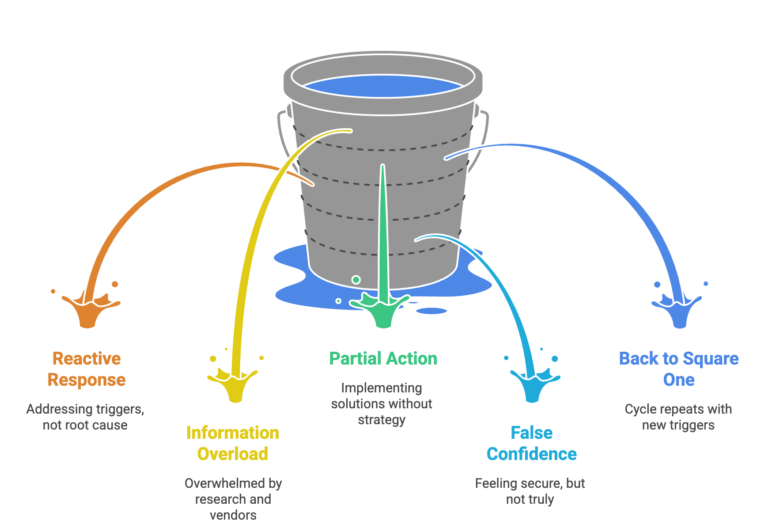
Here’s what the decision-making process looks like for most businesses without dedicated cybersecurity expertise:
Step 1: Reactive Response
Something triggers concern—a client questionnaire, an insurance renewal, a news story about a breach similar to yours. You realise you need to do something about cybersecurity.
Step 2: Information Overload
You start researching. Google returns millions of results. Every vendor claims their solution is critical. Security frameworks have hundreds of recommendations. The more you read, the more overwhelming it becomes.
Step 3: Partial Action
You implement something—usually whatever seems most urgent or was recommended by the last person you spoke to. Maybe you upgrade the firewall. Maybe you run a security audit. Maybe you implement a new backup solution.
Step 4: False Confidence
For a while, you feel better. You’ve done something. The immediate concern is addressed. Security feels handled.
Step 5: Back to Square One
Six months later, another trigger arrives. A different client questionnaire. A new insurance requirement. An industry regulation update. And you realise: you’re still not confident about your overall security posture. You still don’t know if you’re focusing on the right things. You’re back to guessing.
This cycle repeats endlessly because the fundamental problem hasn’t been solved: you’re making security decisions without security expertise.
Why General IT Support Isn't Enough
Many businesses assume their IT support provider handles cybersecurity. And in a sense, they do – but there’s a critical distinction most people miss.
Your IT support keeps your environment secure operationally. They patch systems, configure firewalls, manage antivirus, respond to incidents, and maintain security configurations. This is essential – it’s your security foundation.
But operational security and strategic security are different capabilities:
Operational Security (What IT Support Provides):
- Keeping systems patched and updated
- Maintaining secure configurations
- Responding to security incidents
- Implementing technologies when requested
- Following best practices
Strategic Security (The Missing Layer):
- Assessing current maturity against recognised frameworks
- Prioritising improvements based on risk and business context
- Building systematic capability over time
- Collecting evidence for certifications and audits
- Demonstrating maturity to insurers, clients, and regulators
Think of it this way: operational security keeps your house locked and the alarm working. Strategic security ensures you’re protecting the right rooms, meeting building codes, and can prove it to your insurer.
You need both. But most businesses only have the operational layer.
The Framework Gap
When businesses do seek strategic guidance, they often turn to security frameworks like Essential Eight or ISO 27001. These frameworks are excellent – they represent best practice distilled from thousands of organisations’ experiences.
But here’s what many businesses discover: frameworks tell you what good security looks like. They don’t tell you how to get there from where you are now.
Essential Eight, for example, specifies eight critical controls. For each control, it defines three maturity levels. The documentation is comprehensive and freely available.
Yet businesses still struggle to implement it. Why?
- Prioritisation: Which control should you implement first? The answer depends on your current environment, industry, risk profile, and capacity. The framework doesn’t tell you.
- Implementation: The framework says ‘implement application control.’ But how? Which technology? What’s the rollout sequence? How do you handle exceptions? The framework doesn’t specify.
- Verification: You’ve implemented what you think is application control. But is it configured correctly? Will it pass audit? The framework doesn’t verify.
- Evidence: You need to prove compliance. What evidence do auditors expect? When do you collect it? The framework doesn’t guide evidence collection.
- Momentum: Implementation takes months. How do you maintain progress when business priorities shift? The framework doesn’t provide accountability.
Frameworks are maps. But maps don’t navigate for you. You still need a guide who knows the territory.
The One-Off Audit Trap
Recognising they need expert guidance, many businesses commission a security audit or assessment. This seems logical: get an expert to evaluate your security and recommend improvements.
And it works – to a point. You receive a comprehensive report identifying vulnerabilities and recommending controls. For a moment, you feel clarity. Finally, someone has told you what to do.
Then the report arrives. Forty-seven recommendations. Prioritised as ‘Critical,’ ‘High,’ ‘Medium,’ and ‘Low.’ All valid. All important. All overwhelming.
Now you face new questions:
- Should we tackle all the ‘Critical’ items first, even though some are expensive and complex?
- Or should we pick some ‘Quick wins’ to build momentum?
- Six months from now, will these priorities still be right?
- How do we know if we’re implementing them correctly?
- What evidence should we collect to prove we’ve addressed each recommendation?
The audit provided a snapshot. But you need ongoing navigation. Without continued guidance, most audit reports end up filed away, with scattered implementation attempts that never build into coherent security maturity.
One-off audits create what we call ‘Point-in-Time Clarity’—you understand your security posture on the day of the audit. But security is a journey, not a destination. The clarity fades as your environment changes, threats evolve, and you implement controls without verification.
What Strategic Cybersecurity Guidance Actually Looks Like
So if awareness isn’t enough, frameworks need interpretation, IT support handles operations not strategy, and one-off audits leave you stuck—what does work?
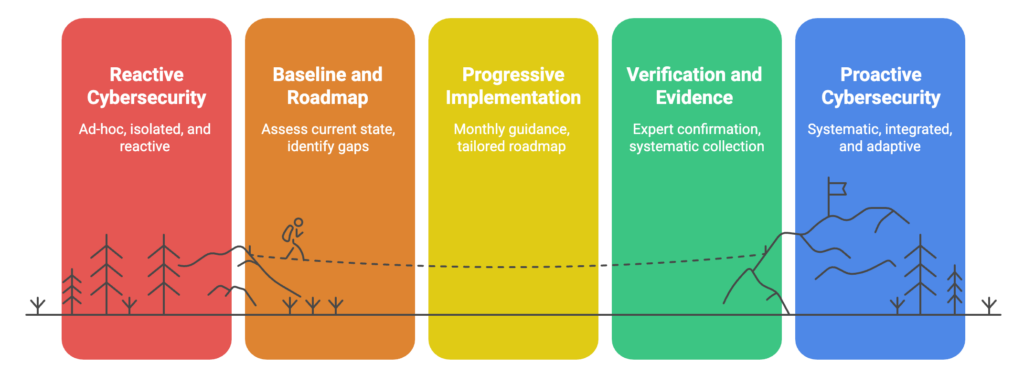
Strategic cybersecurity guidance provides what’s missing: ongoing expert advice that helps you make informed decisions month by month.
Here’s what that looks like in practice:
Month 1: Baseline and Roadmap
Assess where you are across recognised frameworks. Identify what you’ve already implemented and where gaps exist. Create a prioritised roadmap based on your specific situation—not generic recommendations, but tailored guidance considering your industry, risk profile, budget, and capacity.
Months 2-12: Progressive Implementation
Monthly meetings guide you through implementing the next controls on your roadmap. Not rushed—at a pace that suits your team’s capacity. Some months you tackle multiple improvements. Other months you focus on embedding one change properly whilst managing other business priorities.
When obstacles arise, you have expert guidance to overcome them. When circumstances change, the roadmap adapts. When new threats emerge, priorities adjust.
Throughout: Verification and Evidence
As you implement each control, expert verification confirms it’s done properly. Evidence is collected systematically—not scrambled together when audit time arrives. When you’re ready for certifications, everything is organised and prepared.
This approach transforms cybersecurity from guesswork into systematic capability building. You’re not wondering if you’re doing the right things—you have ongoing expert confirmation. You’re not stuck implementing an audit report in isolation—you have continuous guidance adapting to your reality.
Moving Beyond Awareness
The businesses that make real security progress aren’t necessarily the most aware of cybersecurity risks. They’re the ones who’ve moved beyond awareness to action guided by expertise.
They’ve recognised that:
- Knowing cybersecurity matters isn’t the same as knowing what to do about it
- Operational IT security and strategic security guidance are different capabilities
- Frameworks provide the destination but not the navigation
- One-off audits create clarity that quickly fades without ongoing guidance
- Security maturity is built through consistent, expert-guided progress—not reactive responses to the latest concern
The question isn’t whether cybersecurity is important. You already know it is.
The question is: do you have the strategic guidance needed to make meaningful progress on your cybersecurity?
If you’re stuck on the Awareness Plateau – knowing cybersecurity matters but uncertain about next steps – it might be time to consider strategic guidance that helps you move from awareness to action.