The Real Cost of Cybersecurity Decision Paralysis
The most expensive cybersecurity decision most Brisbane businesses make isn’t the wrong product or the wrong vendor. It’s the decision to keep putting off a decision.
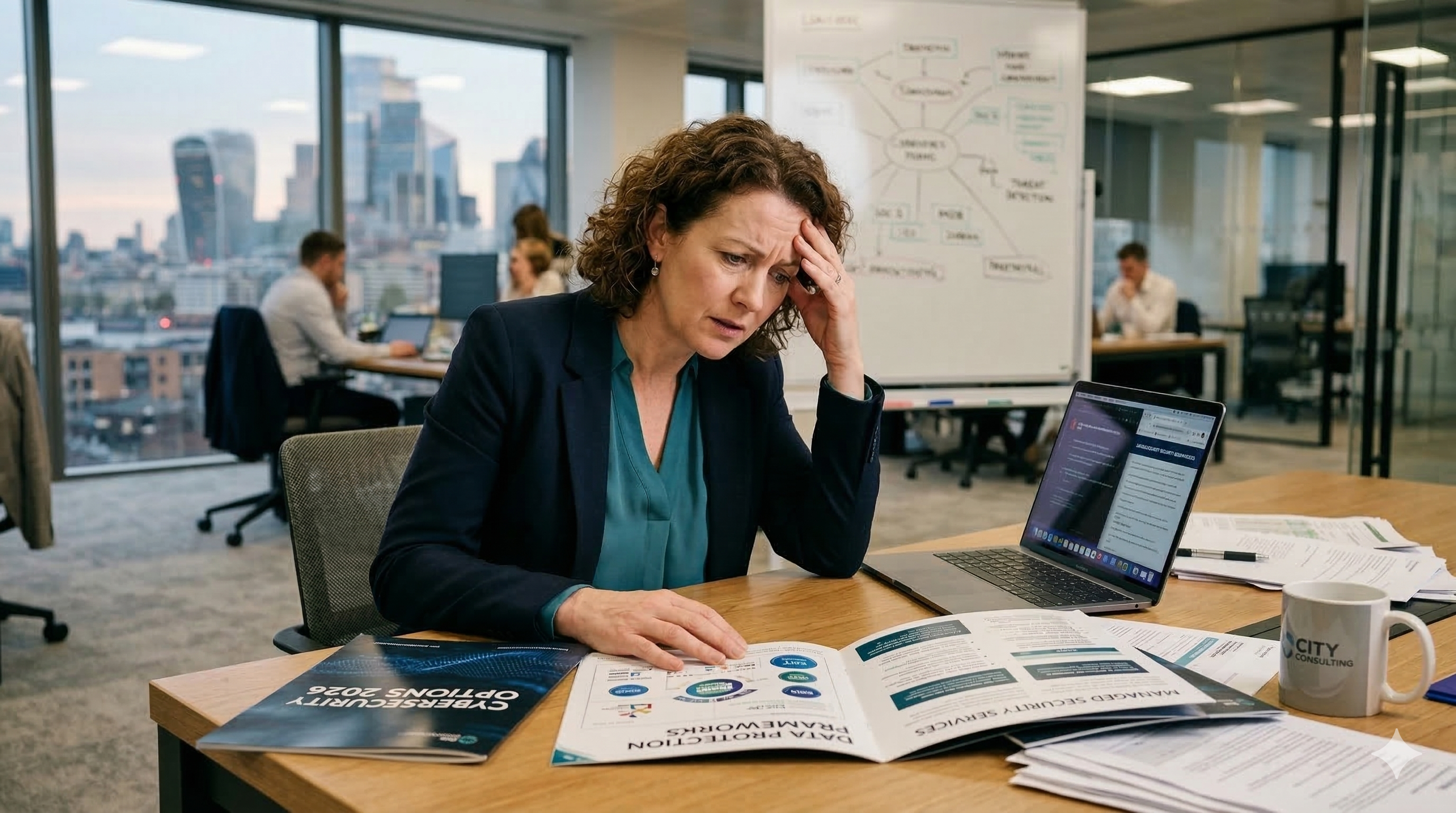
We see this pattern regularly: a business leader knows the security posture needs attention. They’ve probably known for a year or more. So they request a couple of quotes, attend a webinar, bookmark a few articles, and tell themselves they’re being diligent. Meanwhile, the calendar moves forward and the actual risk doesn’t go anywhere.
What looks like prudent deliberation is often something else: decision paralysis. And unlike a bad vendor choice, which you can reverse, paralysis has a way of quietly running up a bill that never appears on an invoice.
Why Smart People Delay Cybersecurity Decisions
Decision paralysis around cybersecurity isn’t irrational. It comes from concerns that are genuinely legitimate.
- Option overwhelm. Every vendor claims their solution is the critical one: firewalls, endpoint protection, security awareness training, vulnerability scanning, penetration testing. Without a trusted framework for prioritising, everything feels equally urgent, which is functionally the same as nothing feeling actionable.
- Budget uncertainty. Quotes range wildly. One consultant quotes $8,000 for an assessment. Another quotes $45,000 for implementation. A third suggests a $120,000 full-time hire. Without context for what your business actually needs, there’s no rational basis for choosing between them.
- Fear of making the wrong call. What if the technology changes? What if the implementation creates a false sense of security? These are reasonable questions, and the stakes do feel high.
- Competing priorities. Cybersecurity sits alongside product development, sales initiatives, and growth investments. It’s easy to tell yourself: we haven’t been breached yet, let’s focus on revenue-generating work first.
All of these concerns are valid. The problem is that whilst you’re carefully weighing them, costs are accumulating in ways that don’t show up until it’s too late to avoid them.
The Hidden Costs of Delayed Decisions
Decision paralysis carries real costs: most of which don’t appear on invoices or in budgets. Here’s what accumulates whilst you delay:
Cost 1: Rising Insurance Premiums
Cyber insurance premiums have increased 50-100% over the past three years. Insurers now require detailed security questionnaires. Without demonstrated maturity: certifications, documented controls, evidence of ongoing management. You’re in the high-risk category.
The cost: For a typical Brisbane business, the difference between high-risk and demonstrated-maturity premiums can be $5,000-15,000 annually. That’s $60,000-180,000 over three years of delayed security improvements.
Cost 2: Lost Tender Opportunities
More RFPs require security certifications or demonstrated framework compliance. If you can’t tick those boxes, you’re not even shortlisted. Your competitors with Essential Eight or ISO 27001 certifications win by default.
The cost: How many tenders have you declined or not pursued because you knew you couldn’t meet security requirements? Even one missed $100,000+ contract dwarfs most security investments.
Cost 3: Client Confidence Erosion
When clients send security questionnaires and you can’t answer confidently, you’re creating doubt. “We’re working on it” or “That’s on our roadmap” sounds like you’re not taking their data seriously.
The cost: Client relationships are hard to quantify, but erosion is real. Clients who lose confidence in your security posture start evaluating alternatives. By the time they switch, it’s too late to rebuild trust.
Cost 4: Leadership Time Waste
How many hours have you and your leadership team spent researching cybersecurity, getting quotes, attending vendor demonstrations, reviewing proposals, and discussing options without reaching decisions?
The cost: If your leadership team has spent 10 hours monthly for six months researching without deciding, that’s 60 hours. At $200/hour opportunity cost, that’s $12,000 spent on indecision, with nothing to show for it.
Cost 5: Catching Up Is More Expensive
When you finally must improve security, because an insurer demands it, a client requires it, or a regulation mandates it, you’re implementing under pressure. Rushed implementations cost more:
- Premium rates for urgent work
- Mistakes from rushed deployment
- Business disruption from quick changes
- Lack of proper evidence collection
The cost: Urgent security projects typically cost 30-50% more than planned implementations. Plus, quality suffers when you’re racing deadlines.
Cost 6: Regulatory Exposure
Privacy and security regulations are tightening globally. The Australian Privacy Act amendments, mandatory breach notification requirements, and industry-specific regulations all increase compliance obligations.
Businesses that haven’t built security maturity face regulatory risk. When breaches occur, and statistically, they will, demonstrable security efforts influence both regulatory response and public perception.
The cost: Regulatory fines, legal fees, remediation costs, and reputational damage. For Australian businesses, data breach costs on average $4.26 million according to IBM’s 2024 Cost of a Data Breach Report.
The Opportunity Cost of Inaction
Beyond direct costs, decision paralysis carries opportunity costs: benefits you forgo by not improving security:
Competitive Advantage Lost
Security maturity is becoming a competitive differentiator. Businesses that can demonstrate Essential Eight compliance or ISO 27001 certification win contracts against competitors who can’t. They command premium pricing because clients value demonstrated security.
Whilst you delay, competitors are building this advantage.
Strategic Clarity Missed
Businesses with strong security posture make better strategic decisions. They can confidently pursue cloud migrations, enable remote work, adopt new technologies, and expand into regulated industries: all opportunities that require security confidence.
Decision paralysis on security creates decision paralysis on strategy.
The Cost of Deferring
There’s a psychological cost to ongoing uncertainty. Business leaders who aren’t confident in their security spend mental energy worrying. Every news story about a breach triggers anxiety. Every client questionnaire creates stress.
Confidence in your security posture frees mental bandwidth for growth activities.
What Breaks the Paralysis
Understanding the costs of inaction helps, but it doesn’t answer the underlying question: where do you actually start?
In our experience, what breaks the cycle isn’t more information. It is structure. Most of the businesses we work with that have been stuck in research mode for months aren’t lacking data; they’re lacking a decision-making framework and someone they trust to guide them through it.
Trusted guidance matters more than most people realise. When you’re evaluating vendors who all have an interest in the outcome, you can’t get unbiased prioritisation. What actually moves things forward is an adviser who can look at your specific situation and say: given where you are, here’s what matters first, and here’s what can wait.
Recognised frameworks like Essential Eight and SMB1001 are genuinely useful here, not because they make the decision for you, but because they dramatically reduce the number of decisions you need to make. Instead of evaluating every possible security improvement against every other, you’re working through a structured set of proven controls that insurers, clients, and regulators already recognise. The scope becomes manageable.
Staged investment helps too. You don’t need to commit to everything at once, and framing security improvement as a 12-month journey rather than a single project changes the calculus entirely.
But the thing that matters most, and what we see makes the biggest difference, is simply a clear starting point. Most businesses delay because they don’t know where they currently stand. A baseline assessment against a recognised framework gives you that. Once you know the gap between where you are and where you need to be, the next decision becomes obvious rather than overwhelming.
The Cost-Benefit Reality
Let’s put the costs of inaction into perspective with actual numbers:

Meanwhile, strategic cybersecurity investment typically ranges from $30,000-60,000 annually for comprehensive guidance and implementation.
The question isn’t whether you can afford to invest in cybersecurity. It’s whether you can afford to keep delaying.
Breaking Free From Paralysis
If you recognise your business in any of this, the path forward is simpler than the research phase has probably made it feel.
The gap between where most businesses are and where they need to be is almost always smaller than the paralysis suggests. And the businesses that finally move forward consistently say the same thing: the relief of having a concrete plan, rather than an open-ended research project, was immediate. The hard part wasn’t the work. It was making the first move.
Start by acknowledging that inaction has a cost. Then get a baseline. From there, the decisions get progressively easier, because you’re working from facts rather than estimates.
If you’d like to understand where you currently stand, a baseline assessment against Essential Eight or SMB1001 is the natural first step.
The Bottom Line
The businesses that make real security progress aren’t necessarily the ones with the biggest budgets. They’re the ones who’ve recognised that structured action, even imperfect action, beats indefinite research.
If you’ve been stuck in cybersecurity decision paralysis, calculate what delay is actually costing you. The number might surprise you, and it might be exactly what finally moves things forward.
Ready to move from research to action? The first step is understanding where you currently stand. A baseline security assessment can break decision paralysis by giving you concrete starting point. Contact us today to discuss your current cybersecurity posture and next best steps forward.