Five signs your cybersecurity is strong but unprovable
Your security tools might be doing their job. The question is whether you can demonstrate that to anyone who asks.
There’s a version of cybersecurity that feels solid from the inside but falls apart the moment someone asks you to account for it. The tools are there. The IT team or provider is on top of things. Nothing has gone wrong. And yet, if a cyber insurer, an enterprise client, or your own board asked you to demonstrate your security posture tomorrow, you’d struggle to know where to start.
This is more common than most business owners realise, and it’s becoming a genuine liability. Here are five signs you might be in this position.
1. You rely on your IT provider to answer security questions on your behalf
Cyber insurance is the most immediate place this shift is showing up. Not long ago, insurers would run through a checklist at renewal: multifactor authentication, regular patching, offsite backups. A yes across the board and you’d get your policy.
That process has changed substantially. Australian cyber insurance underwriting tightened significantly through 2024 and 2025. The informal tick-and-flick application form has been replaced by detailed technical questionnaires, and for higher cover, evidence of controls. Businesses that haven’t invested in structured security practices are increasingly finding that cyber insurance is either expensive or simply unavailable.
The market is also about to get more costly. After two years of softening rates, S&P Global forecasts a 15 to 20 per cent premium increase in 2026. Organisations with strong, documented security postures will be better placed to negotiate favourable terms. Those without them won’t.
There’s also a significant coverage gap that most business owners aren’t aware of. Only 10 to 20 per cent of businesses currently carry cyber insurance, compared to 40 to 50 per cent of mid-market firms. That means the majority of small businesses are carrying a risk they’ve largely left unquantified, and uninsured.
The procurement picture is similar. If your business sells to enterprise clients or operates in regulated industries like financial services or healthcare, you may already be fielding questions about your security posture from clients or partners. Insurers are increasingly requesting third-party security attestations, such as framework certifications or maturity assessments, for cover above $1 million. That expectation is spreading beyond the insurance conversation into tenders, contracts, and supplier assessments. It only moves in one direction.
2. Your security training happens once at onboarding and never again
Staff awareness training is one of the most consistently underestimated controls in a small business security program. It’s also one of the first things that gets asked about in an insurance renewal or a client security questionnaire.
A single induction session from two years ago doesn’t count. Neither does a policy document that lives in a shared drive nobody reads. What insurers and certification frameworks are looking for is evidence of regular, completed, documented training: monthly or quarterly cycles, completion tracking, and accountability for non-completion. If you can’t point to records showing your team is actively engaged with security awareness on an ongoing basis, that’s a material gap regardless of how good your technical controls are.
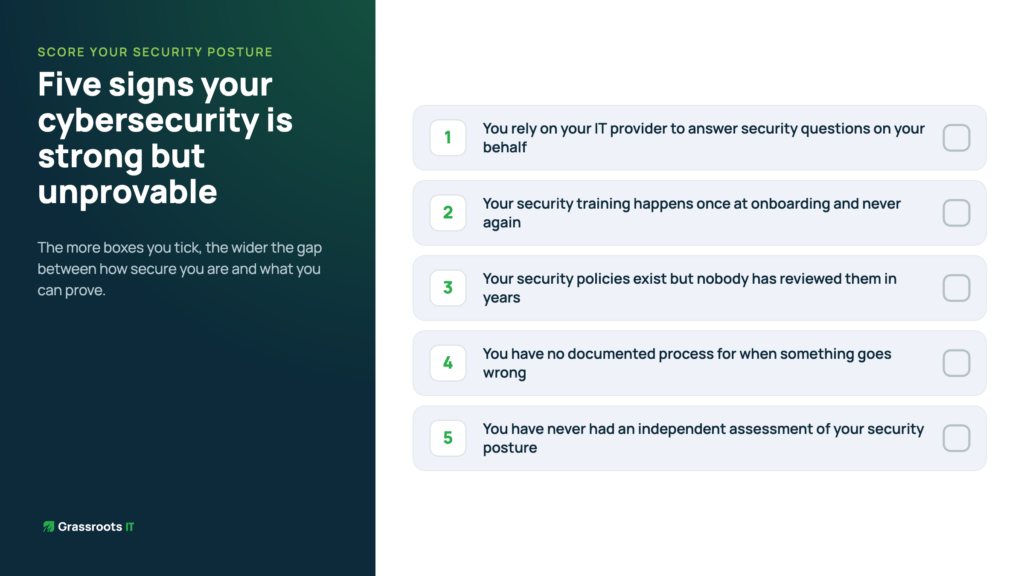
3. Your security policies exist but nobody has reviewed them in years
Most businesses at the 30-to-100-staff mark have some version of a password policy, an acceptable use policy, and possibly an incident response plan. What’s less common is any evidence that those documents are current, reviewed regularly, or actually reflect how the business operates.
Outdated policies are a problem for two reasons. First, they may no longer cover the tools, platforms, and working arrangements the business actually uses. A policy written before the shift to hybrid work and cloud storage is almost certainly missing something. Second, they signal to anyone reviewing your security posture that governance is informal, not a managed process. A document dated 2021 that hasn’t been touched since tells its own story.
4. You have no documented process for when something goes wrong
Most small businesses have a rough idea of what they’d do in the event of a cyber incident: call the IT provider, shut things down, figure it out from there. What most don’t have is a documented, tested incident response plan that assigns roles, defines communication protocols, and sets out a recovery sequence.
This matters more than it might seem. Cyber insurers ask about it directly. More practically, when something goes wrong is the worst possible time to be working out who does what. Businesses that have rehearsed their response, even in a basic tabletop exercise, consistently handle incidents faster and with less collateral damage than those that haven’t. The plan doesn’t need to be long. It needs to exist and be known.
5. You’ve never had an independent assessment of your security posture
Internal confidence is not the same as verified maturity. Most businesses that haven’t had an external assessment tend to overestimate their position in some areas and have genuine blind spots in others. That’s not a criticism. It’s simply what happens when you’re assessing your own work without a reference standard.
An independent gap assessment against a recognised framework gives you something internal review can’t: a clear, objective picture of where you stand, what’s missing, and how significant the gaps are. For most businesses, the result is more reassuring than expected. The foundations are usually stronger than they think. The gaps tend to be in documentation and formalisation, not in the underlying controls. But until you’ve done the assessment, you’re operating on assumption.
What this comes down to
Good cybersecurity and demonstrable cybersecurity are not the same thing. You can have genuinely strong security practices and still be unable to account for them in any meaningful way to an insurer, a client, or a board. That gap is closing as expectations rise, and the businesses that close it proactively are in a significantly better position than those that wait until someone asks.
If any of the five signs above felt familiar, it’s worth understanding where your business actually sits. An independent assessment is a reasonable first step, and for most businesses, the picture is clearer and more manageable than they expect.
Ready to move from research to action? The first step is understanding where you currently stand. A baseline security assessment can break decision paralysis by giving you concrete starting point. Contact us today to discuss your current cybersecurity posture and next best steps forward.