Ask around your office and you’ll probably find AI is already part of the working week. One person drafts emails with ChatGPT. Another summarises meeting notes in Claude. Someone in finance has worked out a clever prompt for reconciling statements, and nobody else knows it exists.
That’s a good sign. Your people are curious and looking for better ways to work. But it usually means AI is happening to your business rather than for it. Everyone has their own method, nothing is shared, and nobody has agreed what can safely be pasted in.
Meanwhile, the pressure to “do something about AI” keeps building. Vendors are switching on AI features, boards are asking for a plan, and there’s often a list of ideas somewhere, most of them borrowed from a LinkedIn post. Knowing where to start with AI matters far more than which tool you choose.
Two questions worth separating
Getting real value from AI comes down to two different questions, and most businesses try to answer them at once.
- Where will AI pay off in our business? Which work is worth automating, and what should change when it is?
- How do we get our team using it well, together? With shared tools, clear guardrails and skills that stay in the business when people move on.
The first is a business question. The second is a capability question. Both matter, and neither starts with choosing a product.
If you’ve already rolled out a tool and it hasn’t delivered, our post Why Microsoft Copilot Isn’t Delivering for Some Businesses looks at the usual reasons.
Finding the work worth automating
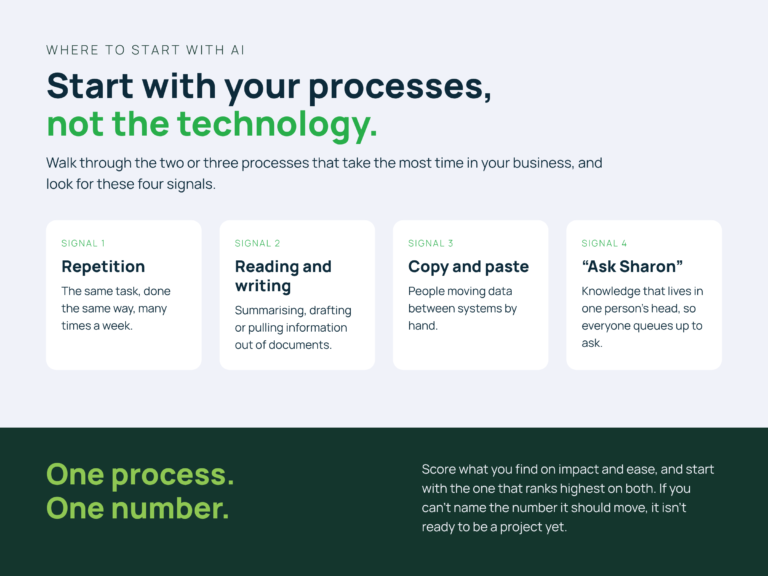
Start with your processes, not the technology. Walk through the two or three processes that take the most time in your business and look for a few signals:
- Repetition: the same task done the same way, many times a week.
- Reading and writing: work that involves summarising, drafting or pulling information out of documents.
- Copy and paste: people moving data between systems by hand.
- “Ask Sharon”: knowledge that lives in one person’s head, so everyone queues up to ask them.
Then score what you find on two things: how much impact it would have, and how easy it would be to do. The best first project sits high on both. Give it a number it should move, such as hours saved, turnaround time or errors caught. If you can’t name the number, it isn’t ready to be a project yet.
Here’s how that might look. An accounts team spends around six hours a week keying supplier invoices into their finance system. It’s repetitive, it involves reading documents, and it’s copy and paste between systems, so it ticks three of the four signals. It scores high on impact, because those hours could go to chasing overdue payments, and high on ease, because most invoices follow a handful of standard formats. The number to move is clear: invoice processing time, from six hours a week to one. That’s a first project you can scope, test and measure.
What this looked like for us
We run this in our own business. With 25 staff and more than 500 helpdesk tickets a week, triaging and assigning tickets used to cost our service coordinator around two days a week. We mapped the process, built an AI workflow around it and had it in production in seven days.
The lesson wasn’t that AI is magic. It was that a clearly defined process, with a clear number attached, is far easier to improve than a vague ambition to “use more AI”.
Getting your team using AI together
The second question is where many businesses quietly lose value. When every good prompt lives in one person’s browser, the know-how walks out the door when they do.
A few practical steps change that:
- One shared workspace the business owns and administers, rather than a collection of personal accounts.
- A one-page AI use policy that says what can and can’t go into AI tools. Our earlier post, Take a Second Before You Paste, covers why this matters.
- Teach it how your business writes, with your style guide and key reference documents, so output sounds like you from the first prompt.
- Turn good habits into reusable skills, so a task one person has nailed becomes something the whole team can use.
- Name a champion who helps everyone else get there.
None of this needs a big project. With someone in the room who has done it before, it can be set up in an afternoon.
Where to start with AI in your business
Pick one process and one number, and ask a simple question: if we fixed only one thing in the next 90 days, which number should move? That gives you a first project you can measure, and a team that learns by doing rather than by reading about AI.
If you’d like a sounding board on where AI fits in your operations, Ben and the team are always happy to talk it through.